Factories today have made huge strides in automation: machines can weld and assemble products, and even inspect them, with amazing precision. Yet, something is still slowing everything down. That “something” is often the way materials move around inside the factory.
When it takes too long for parts, tools, or finished goods to get from point A to point B, the whole process slows down. It leads to delays, wasted labor, and even lower product quality. It is here thatrobotics in logisticscomes into play.
Many factories rely on people to push carts, drive forklifts, or carry supplies between workstations. 但现在, new kinds of robots are taking over those tasks-and doing them better. They are faster, more reliable, and never need a break. Could this be the upgrade your factory needs?
Let’s dive deeper to understand how robotics in logistics is changing the game for factory efficiency.
How Factory Logistics Became the Bottleneck Nobody Talks About
Most people think of automation as something that happens on the production line, where the action is. But behind the scenes, it’s logistics that often play a big role in how well everything flows.
The fact is, even the most high-tech piece of machinery is useless if it doesn’t get the materials it requires at the right time. Wherever a worker is made to wait for parts’ arrivals, production stops. If the finished products have to stay in one place for a long time, then the storage fills up. These minor delays add up in no time.
Manual logistics also has its own problems. Human workers get tired. They make mistakes. It’s hard to maintain the same speed and accuracy throughout a long shift. Not to mention the safety risks involved when moving heavy or awkward materials.
所以, how can factories fix these problems without hiring more people or fully redesigning their workflow?
That’s where robotics in logistics makes all the difference.
What Is Robotics in Logistics and Why It Matters Now
你可能想知道: what exactly do we mean by “robotics in logistics”?
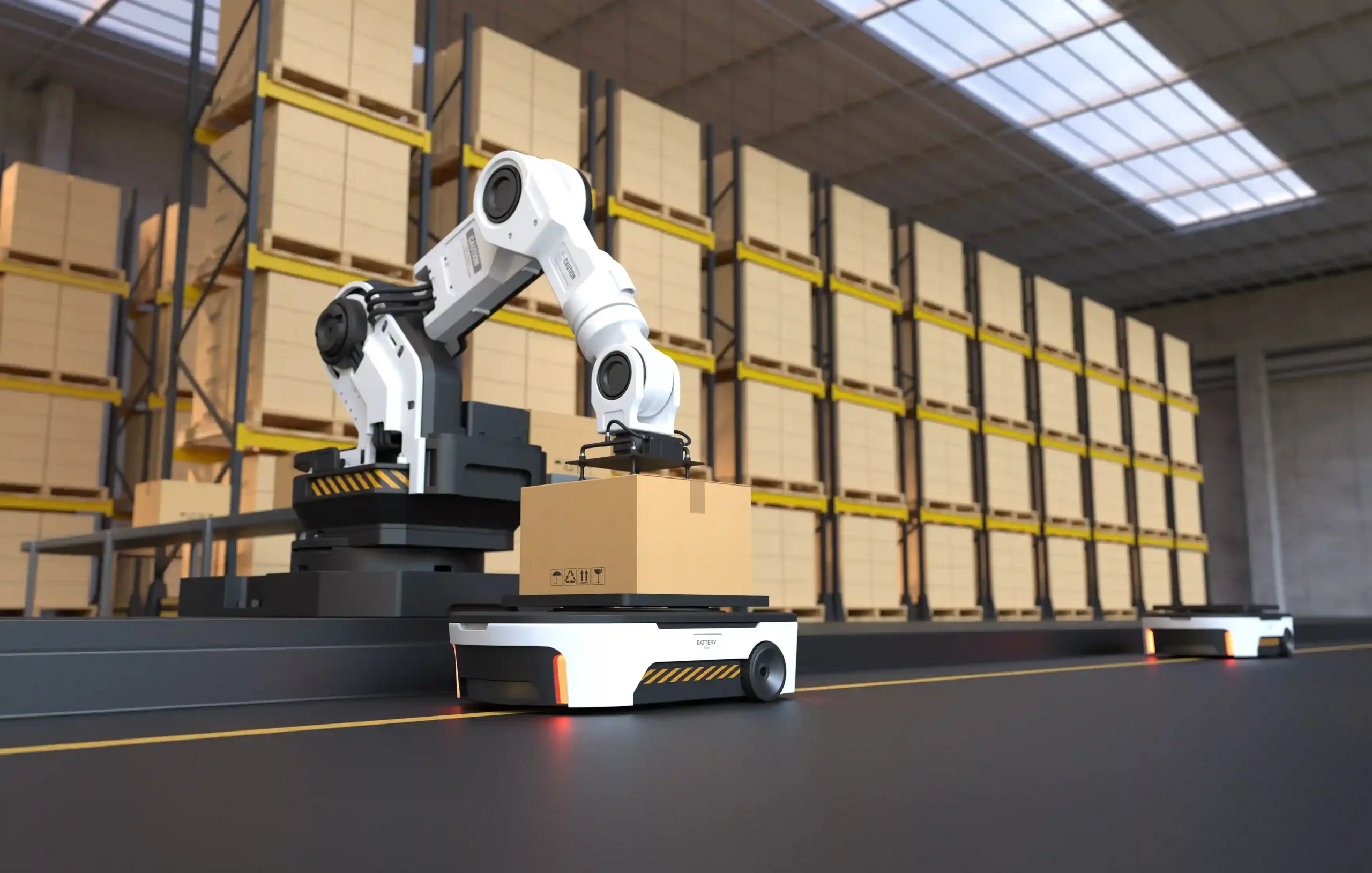
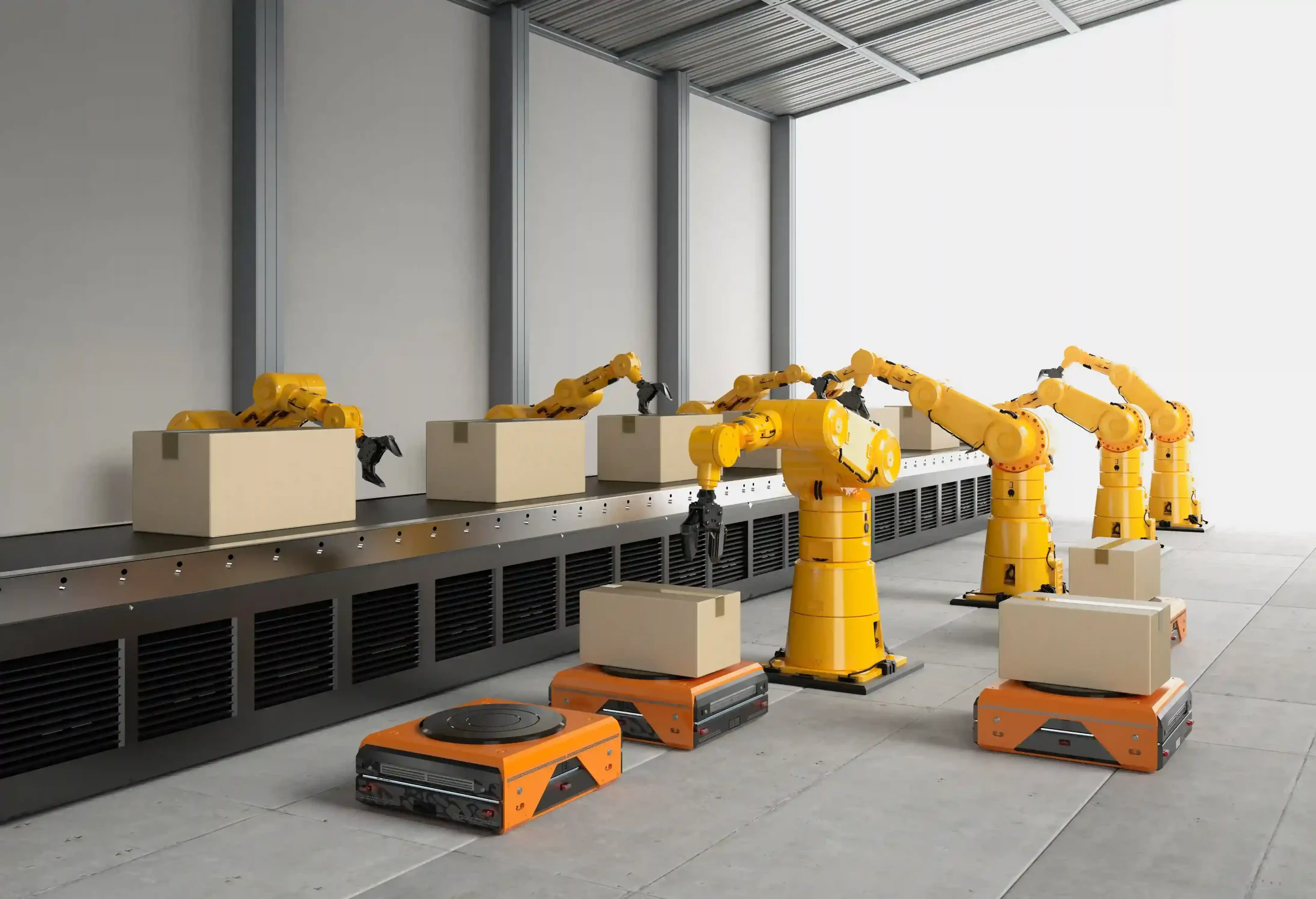
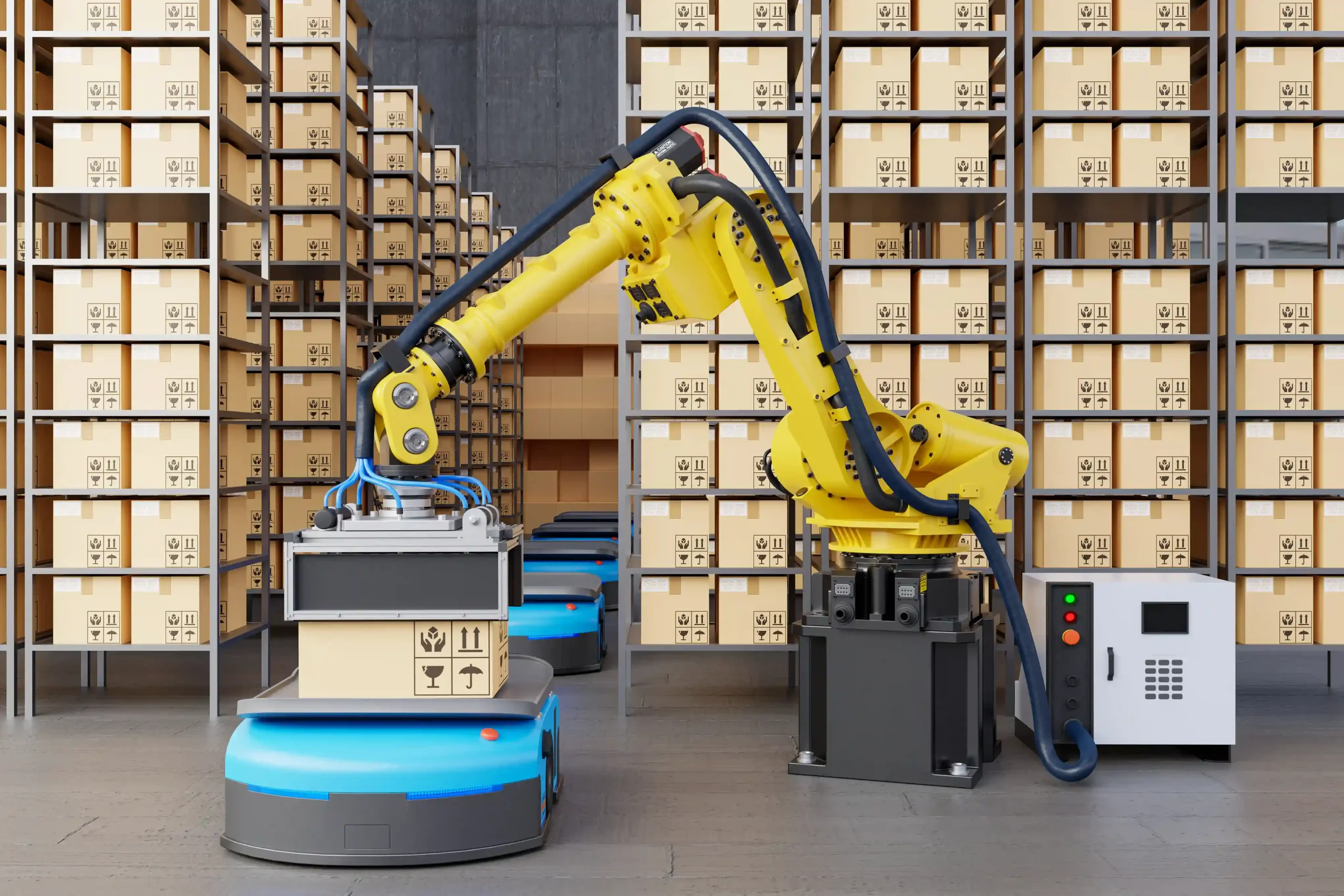
In simple terms, it is the use of robots to move materials around a factory or warehouse. These can come in different forms. Some are AGVs, or Automated Guided Vehicles, which follow set paths. Others are AMRs, or Autonomous Mobile Robots, which use sensors and maps to move freely. Then there are collaborative robots-or cobots-that can work safely alongside human workers.
The reason robotics in logistics is gaining such popularity right now is that the technology has gotten better. The robots are cheaper, smarter, and easier to install. Factories no longer have to spend millions to benefit from automation. Even small and mid-sized manufacturers can get started with a few well-placed robots.
With rising labor costs and frequent shortages of workers, many companies are having trouble finding reliable staff. Robots offer a solution that doesn’t call in sick, take breaks, or leave for another job.
所以, what can these robots do, 确切地?
How Robotics in Logistics Solves Factory Flow Problems
Robotization in logistics, when implemented properly, helps fix many of the common issues that slow a factory down: delays, errors, and safety risks. Let’s take a closer look at how it works.
Picture a robot that picks up raw materials from storage and brings them to the production line — all on its own. Nobody has to push a cart. Nobody waits for somebody to finish a delivery; the robot just goes, and the production keeps flowing.
Or consider a cobot that works alongside a human, sorting and placing items into bins or onto shelves. Humans focus on tasks that require thinking or decision-making, while robot handles the heavy lifting or repetitive work.
The results speak for themselves. Materials arrive on time. Workers stay focused. Production stays on schedule.
Benefits at a Glance
速度: Robots can work much faster compared to human workers, especially for repetitive tasks. They keep the factory running.
Accuracy: Instructions followed to the letter, robots do not get distracted or forget things, hence fewer errors.
Safety: With robots performing hazardous or heavy work, the incidence of workplace injuries can be tremendously reduced.
Labor Savings: Low-skilled or repetitive work requires fewer workers. In this case, human workers might be freed to do higher-value tasks.
灵活性: Most modern robots can be reprogrammed or moved to new areas, which means your system can grow or change as needed.
Now that we understand how robotics helps, the next question is: what kind of impact does it have on the entire factory?
The Real Impact: Boosting Factory Efficiency with Robotics in Logistics
You might think that adding robots only changes one small part of your process, but the truth is, robotics in logistics has a ripple effect and benefits the whole factory.
As materials move faster, machines can run longer without stopping. When errors go down, quality goes up. As employees aren’t stuck doing simple transport tasks, they’re able to do other, more meaningful work at the same time.
Where a logistics factory employs robots in its operations, studies show that its output is increased by 20 到 50 百分比. This represents a vast jump, more so in industries that operate with thin margins.
Factories also report a reduction in missed deadlines, quicker turnarounds, and lower storage costs. Companies save even more money with fewer mistakes in inventory or shipping.
And perhaps most importantly, automation helps factories stay competitive. In today’s global market, being fast and flexible is the key to survival.
Why Now Is the Best Time to Invest in Robotics in Logistics
If you’re wondering whether it’s too early to adopt this technology, the answer is: no, it’s just the right time.
There are a few reasons for this: the cost of robotics has gone down. What used to be only for large, global factories is now available to small and medium businesses.
第二, there is a growing need for automation. After the pandemic, many factories were suffering from a lack of labor. Even now, it is difficult to find sufficient labor for physically tiring and repetitive jobs. Robotics provides a stable solution.
Thirdly, customers are increasingly expecting quicker service and delivery. And if your factory cannot meet this challenge, they will find another one that can. Robotics in logistics helps factories stay quick, lean, and efficient.
Still wondering if it’s the right fit for you? Let’s discuss why OK is worth considering.
Why Choose OK for Your Factory Logistics Automation
There are many robotics providers out there, but OK stands out in a few important ways.
OK focuses on collaborative automation: this means their robots are designed to operate safely alongside people. You don’t need to rebuild your factory or remove your workforce; you just add automation where that makes the most sense.
第二, they offer flexible, cost-effective solutions. Whether you require one robot or an entire fleet, OK can tailor a system to fit your needs. Their team understands how factories work, especially in fast-paced and cost-sensitive markets like Asia.
第三, OK is more than just a robot maker: full support covers everything from planning and installation to maintenance and upgrades. That kind of support gets you real results-not just shiny equipment.
If you’re looking for a partner to help bring robotics into logistics to your factory, OK is ready to help.
结论
Automation in factories no longer means just robotic arms on the production line. Nowadays, it’s all about making every part of the process smarter, especially logistics.
With the use of robotics in logistics, factories can move faster, cut costs, and create a safer, more reliable working environment. Whether you’re trying to boost output or solve labor shortages, this technology gives you the edge you need.
If you’ve been considering how to make your factory more efficient, maybe it’s time to look at what’s going on between your machines — not just inside them.
Have questions or want to explore how robotics can work for you? Contact us at OK.We aren’t here to sell you a robot. We’re here to build together a smarter, smoother, and more efficient factory.
常见问题解答
1. What is robotics in logistics?
Robotics in logistics refers to employing robots for handling tasks that involve moving materials, loading products, and managing inventory in either factories or warehouses.
2. How Robots Improve Efficiency in Factories?
Robots reduce delays, minimize mistakes, and keep materials flowing without breaks. This contributes to quicker production and less disturbance.
3. Are robotics solutions expensive?
Not anymore. Many of the modern robotics systems, such as those from OK, are now affordable and scalable for all sizes of factories.
4. Can robots work along with humans?
是的, cobots are designed to safely work with people, increasing both productivity and safety.
5. Is robotics in logistics only for large factories?
不, small and medium-sized factories are currently adopting robotics to remain competitive and to solve labor challenges.
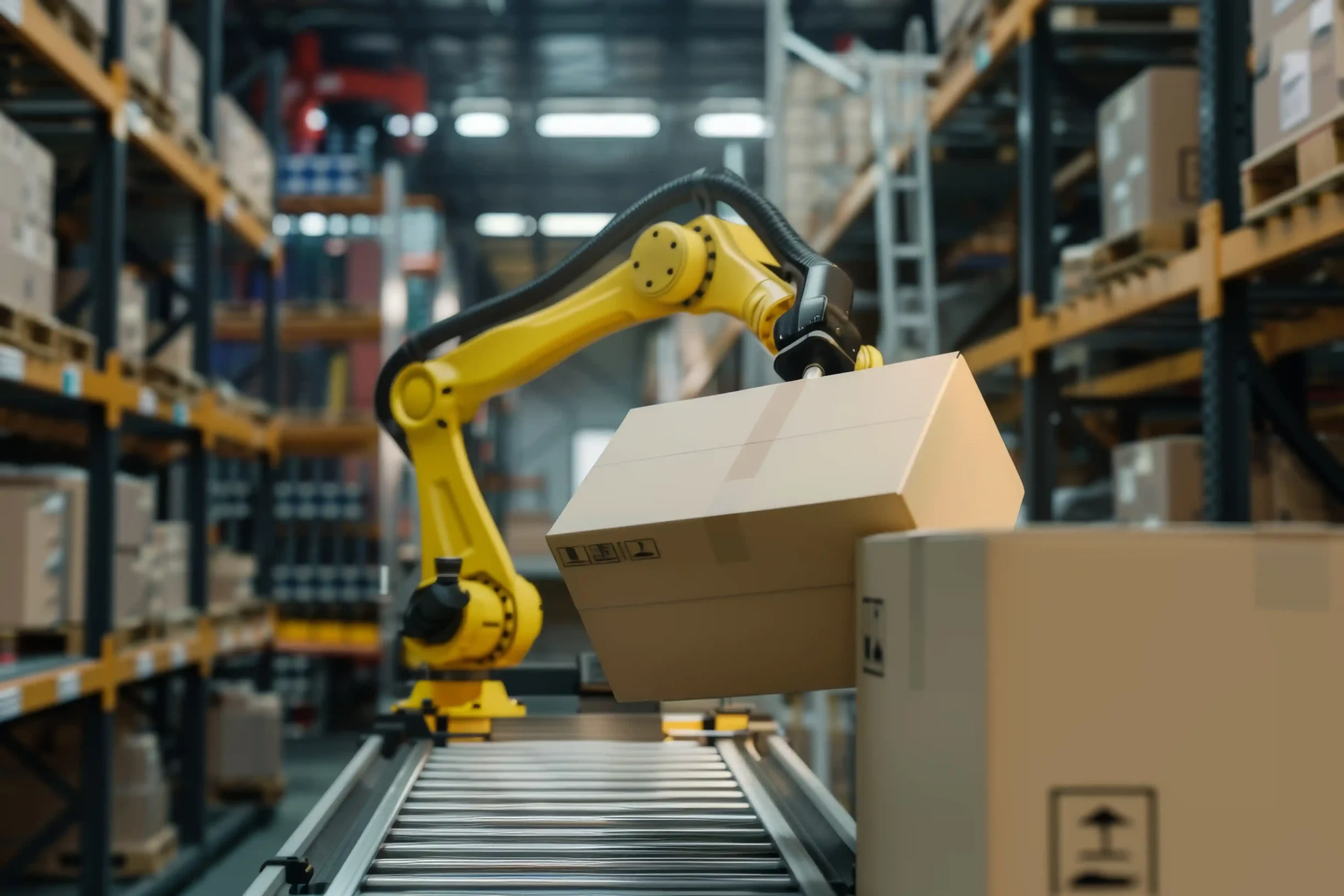
In this era of rapid manufacturing, it’s no longer desirable – it’s mandatory – to be a step ahead of demand. With factories looking to make more, more quickly, for lower prices, many are turning to a revolutionary tool: the box palletizing robot.
What is abox palletizing robotanyway? And why is it becoming even more central to next-gen manufacturing lines? Here’s why this Smarter technology is revolutionizing factory floors and why you are losing ground without it.
What Is a Box Palletizing Robot, and Why Is Everyone Talking About It?
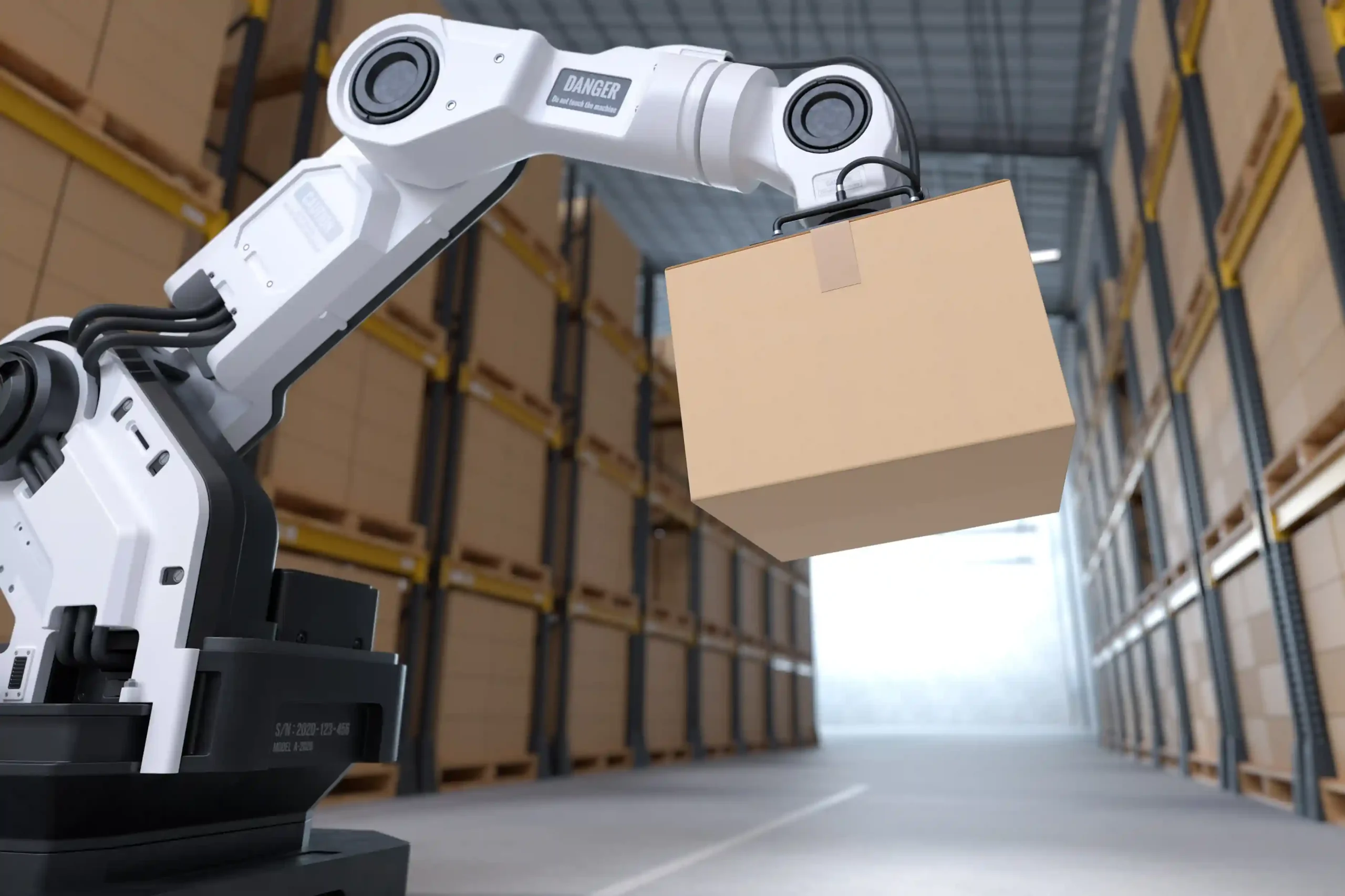
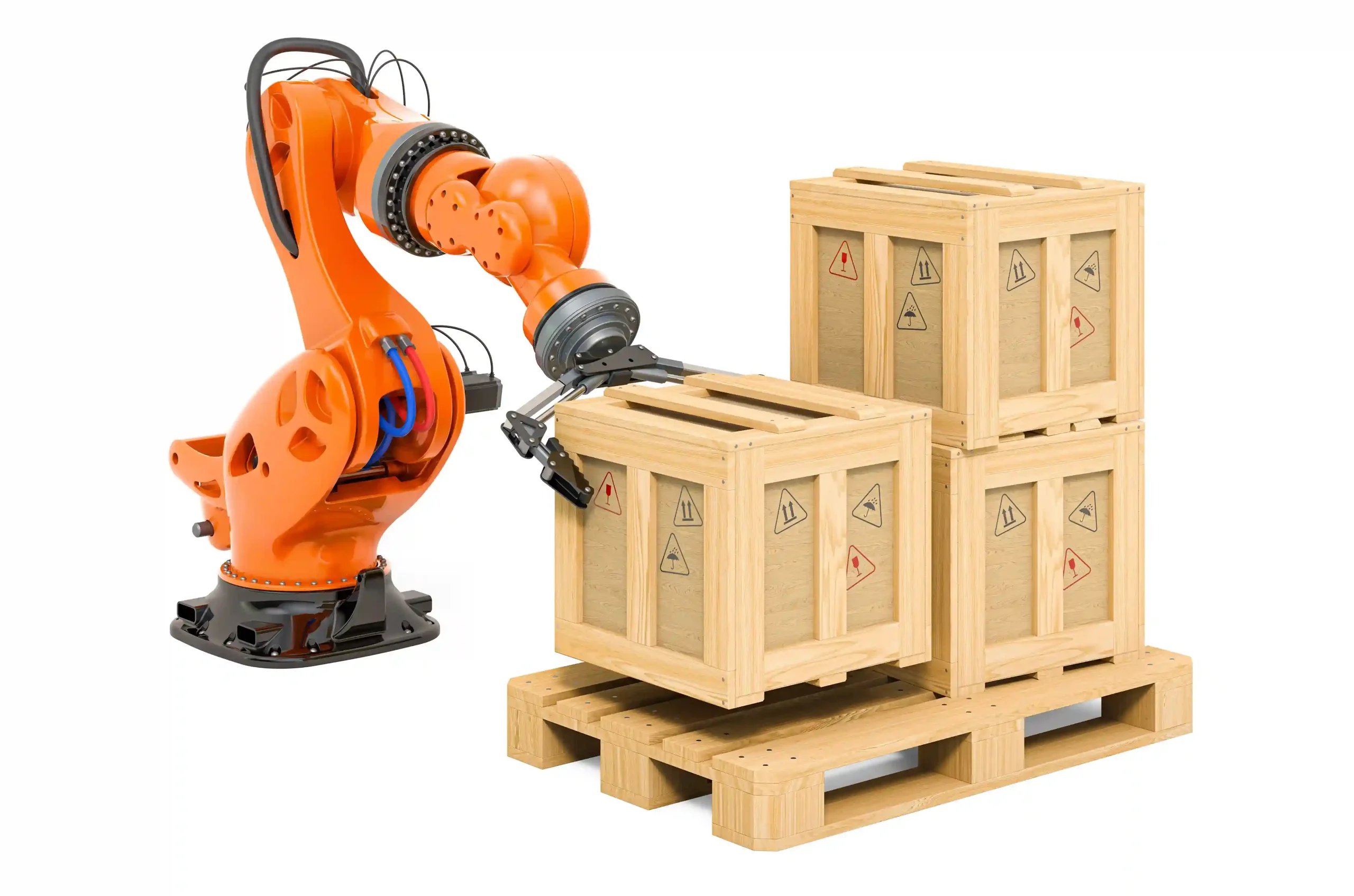
A box palletizing robot is a machine that is used to lift boxes from a stack and pile them in a neat pattern on top of pallets. The robots are typically used at the conclusion of a manufacturing line where boxes containing finished products are placed on pallets for storage or shipment.
Newer palletizing robots are versatile. They can be easily reprogrammed and accommodate numerous box sizes and patterns. Some even are vision-equipped so that robots can “看” boxes as well as adapt to them. Light boxes? Heavy boxes? The robot lifts the heavy load — day in and day out — without fatiguing.
Now that you are educated on what a box palletizing robot is, let’s see why so many factories are automating when it’s time to stack. Is your factory losing money?
Why Manual Palletizing Is Slowing You Down
Manual palletizing, where workers manually lift boxes and stack them up, has always been standard practice. But these days, that’s getting too costly and manpower-intensive. Be honest — eight-plus-hour days of stacking boxes wear on the body. It leads to worker fatigue, injury, and even errors in stacking.
When boxes are not tightly stacked together, they may shift or even drop during transport. The result is damaged merchandise and dissatisfied customers. And since human labor can only go so quickly while workers are taking breaks anyway, your production is capped.
Most factories are already short on manpower. It’s not so difficult to come across people who are ready to do hard, routine labor. This is where a box palletizing robot can come to your literal rescue. It never needs a break and never complains.
But is it money well spent? Let’s see what these robots can actually do.
How a Box Palletizing Robot Makes Your Factory Smarter
Replacing manpower with a box palletizing robot is not just a question of greater speed — it’s a question of functioning more economically. The robots introduce an entirely new dimension of performance to your line.
Improved Speed and Uniformity
A palletizing robot can repeat the same job over and over again without error. Perfectly accurate stacking of boxes, no matter what time it is. This results in quicker packing with fewer damaged items. Human labor can become fatigued and slack off on the job, whereas a robot maintains the same pace from dawn till dusk.
Fewer Injuries and a Safe Workplace
When you leave robots with the heavy lifting, you shield your employees from back strain, muscle aches, and mishaps. Your workforce can transition to safer, more advanced jobs — such as supervision and control of the robot.
Lower Lifetime Costs
Sure, the upfront cost of a robot might seem high. But consider your labor expense, your investment in training employees, and your premiums for insuring employees. And then consider that in one to two years, your box palletizing robot can pay for itself. And then it’s tax-free dollars saved.
You therefore know what it is capable of doing. But what is unique about it compared to traditional industrial robots? Let’s talk about the other big advantage — collaborative automation.
What Makes a Collaborative Box Palletizing Robot Different?
Traditional industrial robots are large, cumbersome, and often fenced off behind security fencing. They are rapid movers that are dangerous when humans are moving in close quarters. The robots are suitable for large factories with open space that can be utilized with a predictable manufacturing output plan.
But most modern factories, especially small- to medium-sized factories, require a more versatile machine. And that’s where cooperative robots — short for cobots — come in.
Smaller, Safer, and Simpler to Use
An F&P collaborative box palletizing robot is designed to be side-by-side with people. It includes features such as force sensors when a person is in close proximity, as well as when moving slowly. This eliminates having a safety cage so that you can position the robot nearly anywhere on the floor.
These robots are also lightweight and portable. Through a touch interface, even a non-programmer can program the robot to stack boxes. You can also modify the pattern of stacking or the size of boxes with a few button clicks.
If you are contemplating whether bringing such a robot as this would be disruptive to your operations, don’t fret — let’s see just how seamless it can be.
Can I Add a Box Palletizing Robot Without Shutting Down My Factory?
Managers’ worst nightmare is typically downtime within a manufacturing facility. But you may be certain of this: The majority of box palletizing robots are plug-and-play robots. And that means you can implement them without substantial changes to your existing installation.
Start Small, Scale Fast
Most installations begin with one palletizing robot serving one line. As it is experienced through its usage, and it is so convenient as well as time-saving, multiple robots are added within different regions promptly.
Works With What You Have Already
You can integrate your robots with your existing Factory equipment. I mean your conveyor lines, your package lines, your software. We can’t tear everything up, and we can’t bring manufacturing to a halt for weeks.
Now that you can view just how effortless it is to get started with them, it is high time to address that grand question: Do you really need a box palletizing robot?
The Bottom Line
Get real. You are not alone with your increased expenses, short timelines, and shortage of labor. Your competitors are in as much distress, and many are addressing those issues with box palletizing robots.
Visualize what your line would be like with increased stacking speed, reduced injuries, and reduced labor expense. What would your crew be able to concentrate on if you didn’t waste hours manually stacking boxes?
Each day that you delay is one that you are losing ground on. The factories that win tomorrow are those that are taking a bet on intelligent automation today.
现在, are you prepared to enter your future?
结论: Ready to Automate the Smart Way?
It’s not replacing your people when you automate with a box palletizing robot. It’s helping them — and your company — to do more. With improved technology, you can be safer, make more, and stay one step ahead of what’s evolving in your world.
You don’t need a big budget or a big team of engineers. All you need is someone who is sensitive to your issues who can guide you to the right solution.
Don’t know where to begin? Call us. We can help you discover the ideal box palletizing robot for your plant, your people, and your manufacturing requirements. Reach out to us now— no hard pitch, simply a nice discussion on taking your factory to the next step.
常见问题解答
1. What is a box palletizing robot?
A box palletizing robot is a machine that stacks boxes on a pallet mechanically in a neat pattern. It is deployed at the terminating point of a manufacturing line to reduce manpower as well as time consumption.
2. How does a box palletizing robot work?
It uses a robot arm with a special tool to lift boxes and stack them according to fixed patterns. It can be programmed and is capable of running without much human interference on a continuous basis.
3. Is it safe to be used with humans?
是的, especially if it’s a collaborative robot (cobot). These robots have safety sensors and slow down or stop if someone gets too close.
4. Will a box palletizing robot accept boxes of different sizes?
是的. Many robots can be set up to receive many different box sizes and patterns. Some are fitted with advanced sensors or vision to aid this.
5. Will I be required to cease production to install one?
None. Lightweight palletizing robots are sometimes so light that you can integrate them with your current line without having to stop it.
6. How much space does a box palletizing robot take up?
Very little. Some are small enough to fit within small places. Cobots do not require safeguard enclosures, so they take up even less space.
7. Is it difficult to educate someone on how to operate the robot?
None whatsoever. The majority are self-learning with intuitive touch controls. No coding is typically required.
8. How fast can I expect to see results?
Most factories experience improved work speed, reduced injuries, and improved stacking within days. Many pay off the robot within 1 到 2 years.
9. Will I be able to transfer the robot to another line later?
是的. Most box palletizing robots are portable or can be moved easily when your layout changes or your needs evolve.
10. How can I get advice on selecting a suitable robot?
Call us at OKBOLONG. We are always ready to assist you in finding a suitable box palletizing robot for your factory and goals.
In this fast-paced era of business life, factories are always seeking to produce more in a matter of minutes. If you are in charge of a packaging plant or product assembly line, there is no question: time is money. That’s why increasingly companies are looking at corrugated carton box making machines. The machines are transforming packaging as we know it and are enabling factories to boost productivity by as much as 40 百分比.
But what are these machines anyway? How do they contribute so much? And why are these machines gaining popularity among industries?Find out below how a corrugated carton box making machine can impact your factory big time.
What is a Case Machine and Sealer Machine?
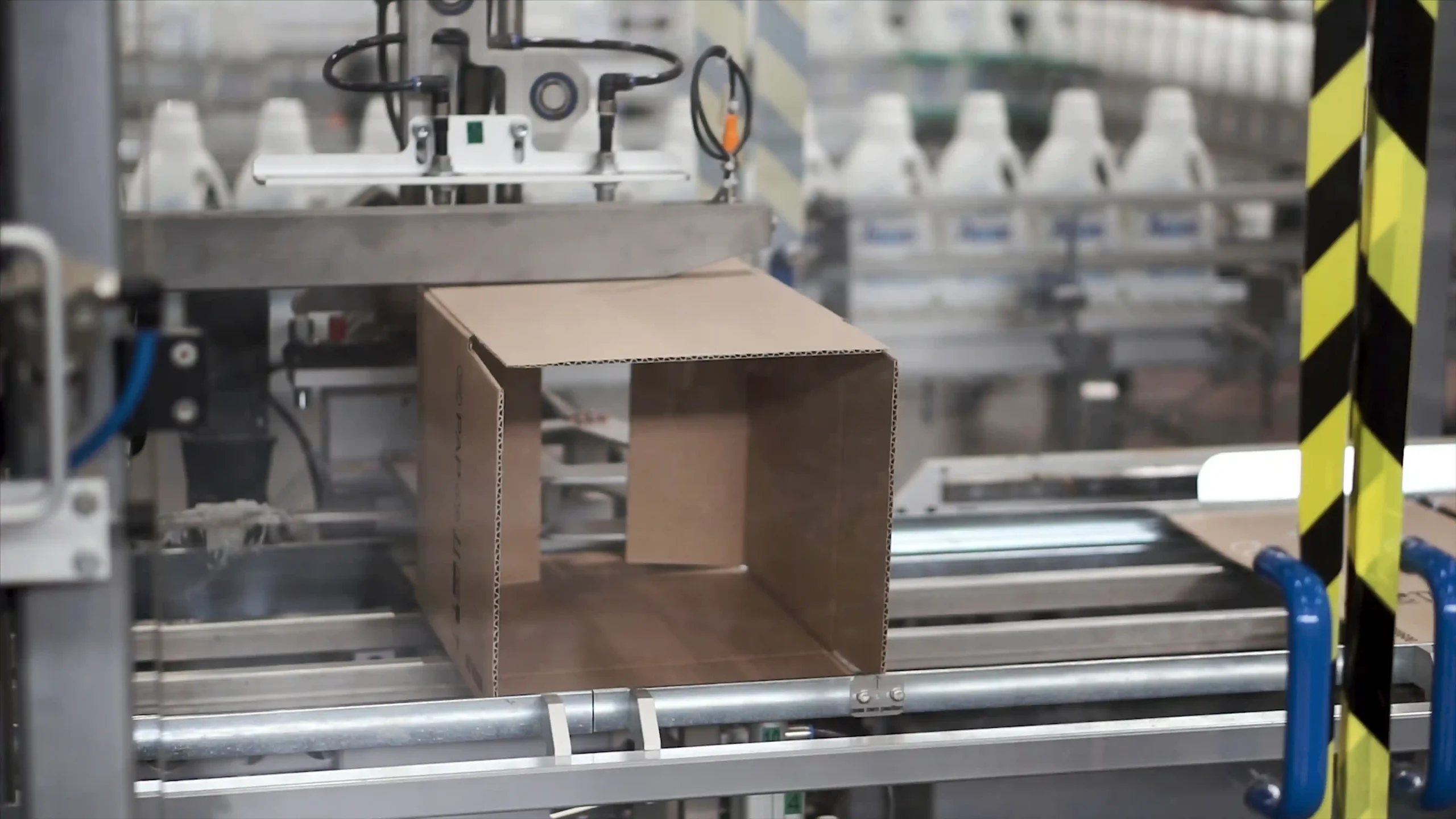
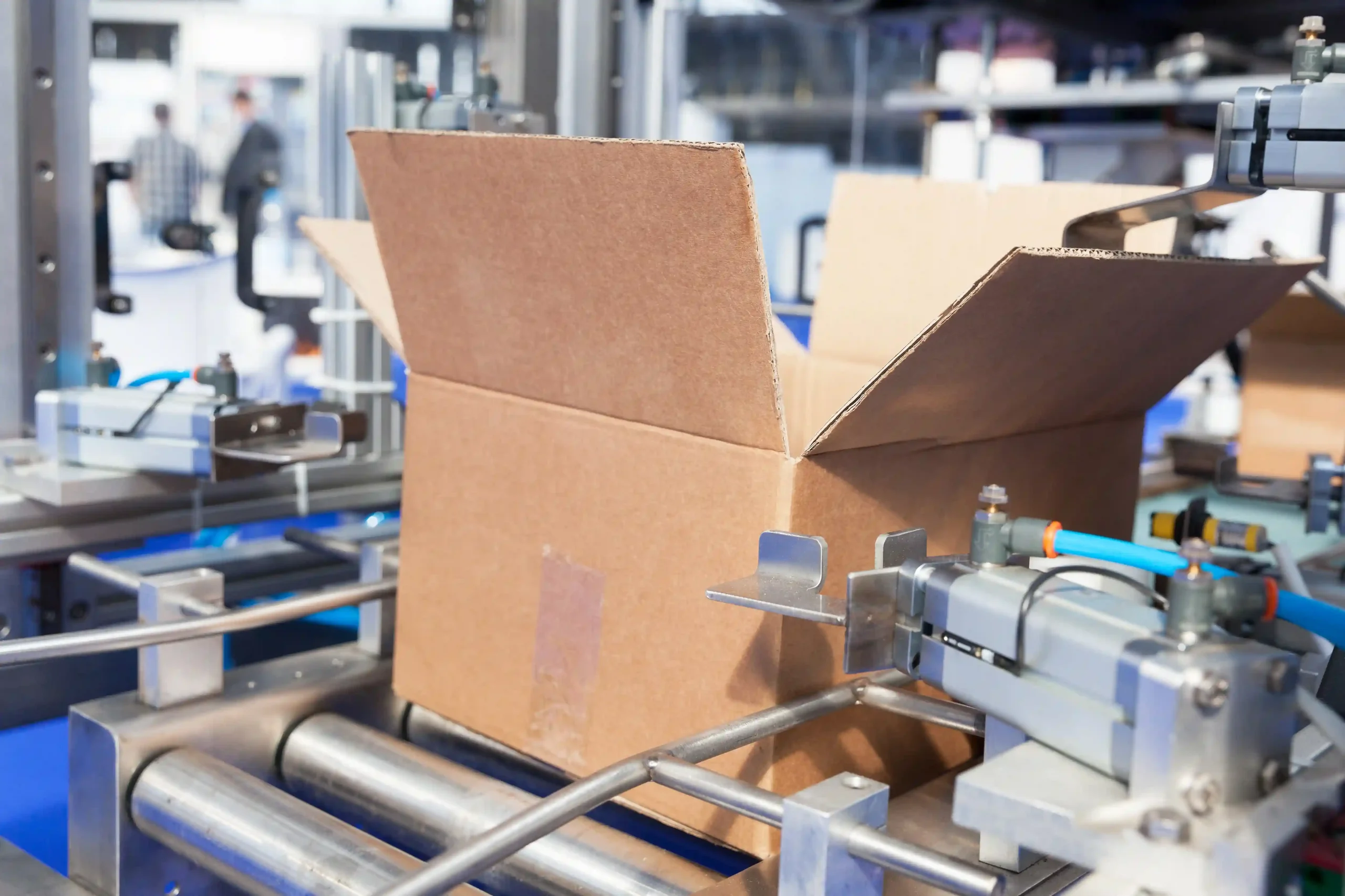
Now that we know what those machines are for, let’s see how they boost productivity.The carton opening and sealing machine is equipment for the logistics and manufacturing industries. It can automatically complete the unpacking, 成型, bottom sealing and carton sealing of cartons. It is highly efficient and provides stable packaging. It is suitable for cartons of various specifications and is used in food, 药品, e-commerce and other fields.
Unpacking Principle: A vacuum suction cup or robotic gripper removes the top carton board from a stack of flat cartons. A robotic arm or fork mechanism then unfolds the carton into a three-dimensional shape. A pressure plate system and a swing-arm folding mechanism simultaneously form the bottom. 最后, the bottom is sealed with tape or hot melt adhesive.
Sealing Principle: A fully loaded carton is fed into the carton sealer via a conveyor belt. Once a photoelectric sensor detects the carton, the sealer automatically applies tape to the top and bottom openings of the carton and compresses it with rollers to complete the sealing operation.
Varied Types of Machines
According to the product series: there are automatic carton forming machines, automatic paper box forming machines, automatic case packing and unpacking machines, automatic case packing and unpacking machines, automatic paper case packing and unpacking machines, automatic case unloading machines, ETC.
Now that we are familiar with what these machines are, why is it such a big issue when it comes to packaging?
Why Is Productivity a Challenge in Packaging Factories Today?
It’s not that easy to operate a factory. There are so many different procedures that go with manufacturing and packaging products. It can take one minute too long and create big problems. This is why even a second counts in the manufacturing space. Yet, most factories are employing older, slower technologies that aren’t even efficient enough to meet demand.
Common problems that impact productivity
The majority of conventional packaging lines employ discrete machines for discrete stages. It implies that additional labor is required to transfer materials from one station to another. There are greater possibilities of error when hands are involved in stacking boxes manually, folding them up, and sticking them with adhesives.
此外, it is time-consuming when changing from one product variety to another. The machines must be stopped as well as restarted while lost manufacturing time is experienced. Even experienced employees may commit mistakes when undergoing such changes.
所以, how can a corrugated carton box making machine fix these problems?
How Does a Case Machine and Sealer Machine Increase Output by 40%?
Now let’s talk about the good stuff. How do these machines increase efficiency in factories? It’s a matter of speed, automating things, and accuracy.
Automation Minimizes Errors
When people do the same job again and again, it is certain that there are mistakes made. Boxes are misfolded, shallowly attached with glue, or miscut. The errors mean lost materials as well as extra time correcting problems.
Automation ensures that the machine accurately carries out each step. Quality checks integrated along with sensors allow them to identify issues right away. The outcome is reduced defects, wastage, and streamlined manufacturing.
Having seen the highest productivity benefits, it is now appropriate to touch on other benefits that are accrued from the utilization of such machines.
What Are the Extra Benefits of Using a Case Machine and Sealer Machine?
Productivity is a good enough reason to invest in machines such as these, but that is not its only benefit. There are other perks that justify them as a good investment for factories.
Reducing Labour Costs
Because so much is mechanized the ase machine and sealer machine, fewer workers are needed. It might only be necessary to employ one person to oversee the entire operation. This reduces labor costs while capacity is still increased.
Increased Uniformity and Quality
Customers want their packaging to be aesthetically pleasing as well as safeguard their content. Machines can provide that level of accuracy that is difficult to achieve with human labor. The boxes are always delivered in an identical fashion. This consistency enhances the reputation of the factory as well as minimizes returns/complaints.
Better Workplace Safety
Manual packing labor is hard on the physical body. Working with heavy board stacks or operating cutting tools for eight hours may result in injury. The automated machines eliminate hazardous or fatiguing labor to help preserve the employees’ bodies.
Energy and Material Efficiency
New machines are made with reduced energy consumption and less wastefulness as well. Most machines possess power-use optimizing settings as well as sophisticated controls that do not exceed material requirements.
Despite these pluses, why would a firm consider taking machines from OKBOLONG when it can consider other brands within its reach?
Why Choose OKBOLONG’s Case Machine and Sealer Machine
There are plenty of manufacturers available, but OKBOLONG is unique for several reasons. Headquartered in China, the company is known for manufacturing high-quality, reliable, and customizable packaging machines. The machines are deployed across the globe by firms that are concerned with speed, quality, and efficiency.
Designed for Real-World Needs
OKBOLONG’s machines are developed from actual factory challenges. 换句话说, it’s quicker setup time, smoother running, and effortless maintenance. The machines are also customizable as modules, so that bigger factories or factories with different requirements can be accommodated.
Excellent Support and Service
Buying a machine is just a first step. The next thing that matters is after-sales service. OKBOLONG gives you training, remote support, and spare parts service. If a problem arises, you are not left to fend for yourself.
A Smart Long-Term Investment
OKBOLONG machines are constructed to last. With robust components as well as intelligent technologies, machines can last for several years with low maintenance. This assists factories in achieving rapid return on investment while decreasing the overall cost of ownership.
Now that we’ve gone over what’s good for you, you may be asking: Is it time to upgrade?
Final Thoughts
If your plant is suffering from sluggish manufacturing, increased labor expenses, or subpar packing materials, this machine may be your solution. Case machine and sealer machine is more than a machine — it is a wise investment in your plant’s future when you acquire a corrugated carton box making machine.
Consider how much more you would be able to make in one day. Consider reducing labor expenses while you are turning out better boxes. What would be your customers’ reactions if you were shipping sooner and more consistently?
Even with your current system functioning well enough, it is possible that you can explore new horizons with automation. It allows your personnel to concentrate on other pressing matters while it does the tough job for you.
Picking up the appropriate machine may be a difficult decision. That is why we are here for you. We at OKBOLONG don’t just produce machines. We help your factories grow as well as thrive in a fast-paced world that is in constant flux.
If you would like to learn what a corrugated carton box forming machine can do for you in your plant, give us a call. We welcome your questions, we can show you options, and we can help you determine a good fit. No hard sell, no pitch — good counsel from experienced individuals in packaging.
今天联系我们and let’s talk about what’s possible for you.
常见问题解答
1.What is a case machine and sealer machine? Describe its applications?
The carton opening and sealing machine is a piece of equipment for the logistics and manufacturing industries. It can automatically complete the unpacking, 成型, bottom sealing and carton sealing of cartons. It is highly efficient and has stable packaging. It is suitable for cartons of various specifications and is used in the fields of food, 药品, 电子商务, ETC.
2. How does it increase factory productivity?
It eliminates manpower on several stages of packaging with automatic operations, which increases efficiency in output so that up to 40% more can be produced.
3. Can one machine handle different box sizes?
实际上, most machines can be readily reprogrammed to switch box styles and sizes quickly without loss of uptime.
4. Is it difficult to maneuver?
不. The majority of machines are user-friendly with single-operators or twin-operators only. OKBOLONG provides support as well as training.
5. How much maintenance is required?
New machines are constructed to last with minimal maintenance. Daily cleaning and periodic inspection of parts suffice in most cases.
6. Will it lower my labor cost?
是的. As fewer operatives are required to operate the machine, factories also cut down on labour expenses considerably.
7. Why choose OKBOLONG?
OKBOLONG provides high-quality machines, strong after-sales support, and customization options to meet factory needs.
When designing to automate your packaging or manufacturing line, it’s very possible to begin with a single grand question: How much is thePalletizing Robot price? This question is valid in itself, but it is merely part of a far larger picture.
Most entrepreneurs and bosses will start by comparing prices, looking to save a buck or two upfront. But this is the bottom line: emphasizing just the lowest cost possible will cost you in the long run.
However, you actually need to take the following into consideration when palletizing a robot. Take a look.
What Is a Palletizing Robot? Why Do I Need It?
A palletizing robot is a type of machinery that is employed to raise, drop, and stack products onto a pallet. Robotic palletizing is often implemented in manufacturing plants to improve efficiency, precision, and workplace safety. With the growth of labor costs and greater demands for efficiency, a higher number of organizations are using robotic palletizing.
Things to Think About when Purchasing a Palletizing Robot are its Price. But that’s where it all ends. The machines are not initial acquisitions. They are long-term equipment that becomes a component of your regular operations.
Let’s explore why cost oftentimes is the initial and sometimes the singular point of emphasis before discussing further.
Why Pay so Much Attention to Palletizing Robot Price?
Most business owners are pushed to be frugal when it comes to expenses, particularly in business sectors with slim profit margins. Needless to say, they first consider the Palletizing Robot cost. They may shop around for quotes or browse the Internet for the lowest cost.
This all sounds fantastic in theory. But is this the ideal way to select technology that will run your factory day in and day out?
Consider this question from the standpoint of having the lowest price. You may end up buying a machine that doesn’t meet your requirements, needs frequent repairs, or will cost you a lot to maintain. Now the “inexpensive” option is costly.
Then why else are you looking?
What’s More Important Than Robot Palletizing Price?
It’s all about cost. But if you want absolute value for your money, you have to see the complete picture.
Reliability and Uptime
A Palletizing Robot that is reasonably priced is of no value if the machinery keeps failing. Downtime represents lost building time, lost shipping dates, and dissatisfied labor. A higher-priced but reliable robot keeps your lines running.
Ease of Use
Can the workers easily operate and maintain the robot? A few of the less-expensive robots require very experienced programmers even for simple operations. Others, like OKBOLONG, are intelligent and come with a very easy-to-use interface. This allows for quicker training and fewer mistakes.
Incorporation into your system
The robot will become unusable if it doesn’t align properly with your setup. There are firms that overlook the cost incurred in software customization or making machinery adjustable in order to fit the robot. A slightly higher-priced Palletizing Robot could help afford better integration.
After-Sales Support and Service
What follows the setup of the robot? Support indeed makes all the difference. If you choose a partner that will service locally, get back quickly, and offer spare parts, you’re not buying a piece of equipment. You’re investing in peace of mind.
Let’s tally the true cost of ignoring these factors.
What Can Go Wrong If You Only Care About Palletizing Robot Price?
The lowest possible cost might appear to be a saving, but it is frequently the root of hidden issues that eventually come to light.
Recurrent Breakdown
Inexpensive robots are constructed from lower-grade components or are inadequately tested. They thereby break down frequently. It takes time and money for repair work, and your entire manufacturing operation will come to a halt while services are awaited.
Higher Operating Cost
You could save in the beginning on the investment for a Palletizing Robot, but have to pay for power, software upgrades, or qualified man-hours to keep it running. Incrementally, these costs chip away at your profit.
Poor Flexibility
Your business will develop and expand. What if your bot is incapable of accommodating new box arrangements or new stack patterns? Replacing or rewiring it later may end up costing you that much more than getting it right the first time.
Risk to Brand Reputation
Delays, defects, or damaged goods brought about by defective equipment will damage your image. Customers demand reliability, and a dissatisfying experience will impel them to seek elsewhere.
You may already be asking yourself how a better way is actually structured.
How to Choose the Right Robot Without Focusing Only on the Palletizing Robot Price
You need a solution that will weigh cost against long-term investment. Here’s how to do that intelligently.
Begin With Your Needs
Identify what your factory actually wants. Consider speed, type of product manufactured, space requirements, and how the robot will integrate into your day-to-day activities. Understanding this will enable you to find the robots that share your objectives.
Inquire About Total Cost of Ownership (TCO)
Rather than request the cost of the Palletizing Robot alone, inquire about the overall expense for five years or a decade. Consider energy consumption, maintenance service, service upgrades, 训练, and so forth. This will help you have a better idea of where your money goes.
Searching for Tailored Answers
All factories are not the same. A quality supplier will take you by the hand to pick or engineer a system that fits your process. This will cost money up front, but will save time and trouble in the end.
Now let’s talk about a company that understands this approach.
Why OKBOLONG Offers More Than Just a Low-Palletizing Robot Price
Here at OKBOLONG, we understand that cost counts — but performance, service, and results count most. That’s why we’re dedicated to providing you the absolute best value, not the lowest bottom-line number.
Built for Long-Term Performance
Our palletizing robots are built to move quickly, stay stable, and keep running consistently. We incorporate quality parts and intelligent technology that minimizes downtime and optimizes efficiency.
Simple Setup and User Interface
OKBOLONG robots are plug-and-play for a majority of operations. Smart controls and easy-to-use interfaces that are easy for everybody to learn. You don’t have to employ a specialist simply to begin working.
Homegrown Support That You Can Trust
We’re located in China and provide rapid, efficient support. If things don’t work out, we’re here for you – not weeks or days later, but when you need it.
Flexible and Scalable Solutions
Your business will expand. OKBOLONG robots are designed to expand with your business. If you are introducing new products for manufacturing, making layout enhancements, or expanding your base of production, OKBOLONG will expand for you.
Then what are you getting out of it all?
结论
The next time someone asks, “What’s the Palletizing Robot cost?” ask them this:
“Do you want it to be cheap, or do you want it to work for your business?”
A palletizing robot is not a piece of equipment. It’s a partner to your success. If you look beyond the cost and look for value, you’re making better decisions that save you money, 时间, and worry later.
We’re not simply retailing robots here at OKBOLONG. We’re helping factories move smarter, 快点, and bolder.
Let’s Discuss the Future of Your Factory. If you seek the intelligent palletizing solutions that are the right size for your objectives, but not your budget, we are happy to have your request.Contact todayand discover the ideal match for your factory. No high-pressure sales but thoughtful recommendations by experts familiar with your world.
常见问题解答
1. Why is the cost of the Palletizing Robot so diversified between companies?
The cost is dependent upon the features, 速度, load capabilities, construction quality, and service assistance.
2. Is a greater Palletizing Robot investment necessarily a good idea?
Not necessarily. Higher cost may bring forth higher value, but that relies on your requirement for the factory.
3. A small factory pays around how much for a Palletizing Robot on average?
It may cost anywhere between $15,000 和 $50,000, depending on the features and complexity.
4. Is the price inclusive of installation and training?
At times, 是的; at times, no. Be sure to ask for a total quote for all services.
5. Can I use one robot for different products?
Indeed, most palletizing robots are versatile and may accommodate various box sizes or configurations.
6. How long will a robot last?
Most robots, when properly maintained, will last between 8 和 15 years. 7. Is the cost other than the Palletizing Robot cost hidden? 是的. Consider maintenance requirements, software patches, and power utilization.
8. What if the robot malfunctions?
Good suppliers such as OKBOLONG have fast assistance and in-country service.
9. How long does it take to install a robot?
Most of the systems take a few days to install when properly planned.
10. Is OKBOLONG a good value for the money?
是的. OKBOLONG balances performance, support, and affordability for long-term success.
In the modern world of manufacturing, automation is no longer a luxury that just large corporations have. Whether you have a small factory or a large warehouse, the robots are becoming indispensable. Of all the robots available, the palletizing robots are perhaps the most useful for optimizing the way the products are packed and transferred.
The question that really needs answering here is this, 然而: when you are ready to invest in a palletizing robot, how do you identify the appropriatepalletizing robot supplier? Why is that so important to your return on investment (投资回报率)?
Let’s take it step by step and find out why your choice of a supplier is not merely important — it’s crucial.
What is a Palletizing Robot and Why Is It a Game Changer?
Let’s talk about suppliers after knowing a bit about a palletizing robot. Basically, it is a robot that places boxes, 包, or any other product in a stack on pallets for shipping or keeping stored. It does this job expeditiously, smoothly, and without a break.
This type of robot eliminates work that would otherwise employ several persons and a great deal of time. Rather than having to lift burdens all day long, laborers are able to perform higher-level tasks while the robot does the heavy work.
The True Advantages of a Palletizing Robot
Here are several self-evident benefits to the addition of a palletizing robot to your operation:
Rapid manufacturing
Fewer work accidents
Increased utilization of labour
Evenly stacked products and fewer damaged products
All these things add up to something: improved efficiency. And when your manufacturing line improves, your company makes a profit. But it’s not all about buying the machine.
Why Your Choice of Palletizing Robot Supplier Affects ROI
Now that we know a bit better the value of the robot itself, let’s take a step back. It’s not that you’re buying a piece of equipment. You’re signing a long-term contract for a palletizing robot supplier. This is the supplier that will define how the robot will perform, when it will pay for itself, and how much help you will have when things are not quite right.
Well, how does your supplier really impact your ROI?
It Starts With System Design and Integration
A quality supplier doesn’t simply sell a robot and drive off. They will work to design a solution that meets your needs precisely. This means selecting the appropriate robot arm for your operation, the correct gripper for your piece, and programming the robot for your conveyors, your package machines, and your pallet.
Your system operates better when it’s properly designed. Less breakdown, greater speeds through your plant, and fewer errors—all these equate to a quicker return for your investment.
5 Things to Look for in a Reliable Palletizing Robot Supplier
It’s also simple to take cost into account when making comparisons between suppliers. But a lower cost doesn’t always equate to higher performance. Below are five things that actually matter when making the appropriate palletizing robot supplier choice.
Experience Within Your Industry
Businesses are unique. For instance, it isn’t a question of stacking cartons of milk versus palletizing bags of rice. You need a supplier that has experience in your business and the issues that you have.
If your supplier has knowledge of your industry, you benefit from their having better ideas and making fewer blunders that will cost time and money.
Customization and Adaptation
Not every factory is the same. Maybe your products come in many sizes. Maybe your space is tight. A strong supplier will offer customized solutions instead of pushing a one-size-fits-all product.
Long-range flexibility also counts. If your product lineup shifts a year from now, will your robot still be useful to you? A wise supplier will point the way to the future.
After-Sales Support
It’s here that the good or the bad supplier differentiation actually happens. What comes after the robot ships? Does your supplier train your staff? Is emergency assistance provided in the event the system goes wrong?
A responsive help desk minimizes downtime and creates the possibility for your system’s maximum utilization day after day.
System Integration Capability
A robot by itself doesn’t work. It needs to be integrated with other equipment such as scanners, 输送机, 软件, and safeguarding devices. A skilled palletizing robot supplier also understands how to integrate all of these components so that the system is a whole.
Poor integration causes defects and bottlenecks. Good integration causes rapid, dependable manufacturing.
Case Studies and References
Any vendor can guarantee stellar results. But can they deliver? Ask for case studies or speak to companies they have served. Demand evidence that they have provided concrete value to others in their shoes.
This will also give you confidence that your supplier is indeed capable of delivering ROI, and not just hyping it.
Risks of Choosing the Wrong Palletizing Robot Supplier
We’ve gone over how to select a supplier. But when all else doesn’t work and you end up making the wrong choice? It’s costly — and perhaps it’s the wrong type of costly.
Let us consider a few dangers associated with the wrong selection of a palletizing robot supplier.
Delays in Installation and Setup
A poor supplier may not fully understand your needs. This can lead to long delays during installation, causing production to slow down or stop completely.
For every day your line is idle, you are losing money. Speedy setup is key to return on investment.
Increased Maintenance Cost
Faulty robots or poor integrations will culminate in breakdowns. This means higher repair costs and lost time due to downtime.
Even if the robot was cheaper in the initial stage, it could become expensive for you later.
Absence of Future Support
Some of these dealers disappear once they have sold. If you have a problem or need to upgrade your system, you are on your own.
If you’re not getting regular maintenance, small things get broken – the kind that damage your return on investment and your business’s reputation.
Missed Business Targets
In extreme scenarios, the wrong selection of a palletizing robot supplier may result in the failure to achieve major objectives. You will be unable to achieve the quality or the production objectives that may impact your customer relationship or your contracts.
That’s why it’s so crucial for you to find a supplier that’s interested in your business.
How OKBOLONG Helps Maximize ROI as a Leading Palletizing Robot Supplier
At OKBOLONG, we know that the purchase of a robot is where things get started. It’s the day-after-day payoff that the system delivers inside your shop floor that truly counts.
What distinguishes OKBOLONG from the competition in palletizing robots?
Designed for Your Needs
We don’t offer “off-the-shelf” solutions. We work closely with you to understand your space, your products, and your objectives for your manufacturing. From that point onward, we develop a bespoke solution that is a perfect fit.
Expert System Integration
Our engineers are trained to work on whole system integration. If barcode reading, product sorting, or smart sensors are involved, we will see your whole system functioning in complete harmony.
That translates to fewer mistakes and simplified operations that equate to quicker ROI.
Training and Continuing Support
We don’t leave after the installation. We educate your staff, observe the system performance, and are available for assistance in case anything shifts in your manufacturing. Maintenance or upgrade, we are a phone call away.
This is the type of long-term assistance that has a tremendous impact on your overall return on investment.
Final Words
By this point, it’s evident that the selection of your palletizing robot supplier isn’t a trivial matter. It impacts your productivity all the way to your bottom line. A good supplier brings you closer to your objectives and spares you costly blunders.
So before you invest in automation yourself, ask yourself this question: Are you buying a robot all that much — or are you actually investing in a long-term business partner?
At OKBOLONG, we’re not just a robot supplier. We’re your automation partner. If you’re a new company or an existing company that wants an upgrade, we’re here to collaborate for the ideal solution that will suit your company and generate a higher return on investment.
今天联系我们 so that we may inform you how your production line may become stronger and smarter. Let’s create something great together.
常见问题解答 (常见问题解答)
1. What is a palletizing robot supplier?
A palletizing robot supplier doesn’t simply sell the robot–but rather the expertise to design for, install, and maintain automated palletizing machines. An experienced supplier will help specify the proper robot for your products, your overall space needs, and your manufacturing requirements, along with long-range technical service and training.
2. How will the selection of the appropriate palletizing robot supplier impact my ROI?
The right supplier ensures that your system will operate successfully, experience less delay, and cost less for maintenance. They will enable you to get the most return from your investment by offering professional integration, quality equipment, and instant support.
3. Any robot I can utilize for palletizing?
Not necessarily. Various robots are appropriate for various tasks. A reliable palletizing robot manufacturer will advise you to select a suitable one that suits your product weight, size, speed needs, and stack patterns.
4. Is after-sales service a key element for a supplier selection?
是的. An active support team will be able to avoid downtime and address issues quickly, protecting your ROI.
5. Why is OKBOLONG a credible palletizing robot supplier?
OKBOLONG provides bespoke solutions, total system integration, and post-deliverables services—all meant to enable you to accomplish rapid and higher automation outcomes.
When your products are ready to ship, the last thing you need is slow or irregular packaging. Enter thecarton sealing machine. It keeps each box sealed fast and evenly, boosting efficiency as well as product appearance. But is an auto model better for your business, or is a semi-auto one? Let’s break it down into easy steps so that you know the best solution for your requirements.
What Is a Carton Sealing Machine and Why Do Businesses Need One?
Any distribution business will need boxes closed reliably and securely. A carton sealer fast and efficiently closes cartons with the use of tape. It can work with something as small as food boxes or as large as e-commerce packages. It can effectively cut wasted tape, human error, and labor by the hour on a regular basis when implemented correctly.
The appropriate carton seal machine will get your packaging line running smoother, 快点, and more consistently. Manually boxing is slow and inconsistent without one. 所以, what are the advantages that you can have with this kind of packaging equipment?
Benefits of Using a Carton Sealing Machine
Consistent quality: It is closed with the same pressure and alignment on every box.
Higher speed: Machines seal boxes faster than manual work.
Manpower reduction: A single operator can deal with numerous boxes with much less exertion.
Professional results: Neatly sealed boxes build customer confidence.
A carton sealer is not solely a matter of convenience, but rather a quality and efficiency investment. Being aware of its importance, let us then take into account the disparity between the two popular brands.
Semi-automatic carton sealers are a great introduction to automated packaging. They still need one person to fold the flaps and put the boxes in, but they automatically do the taping. After the box is loaded into the conveyor, the box goes through and is taped on the bottom and the top.
The semi-automatic is easy to use, thus suitable for small to medium enterprises. They have varied flexibility, meaning that you can easily accommodate varied carton sizes. However, like any system, they have their disadvantages as well as strengths.
Major Strengths and Weaknesses of Semi-Automatic Models
Benefits
Reasonable purchase cost.
Fast setup and user-friendly operation.
Works on any box size.
Space-saving design accommodates compact spaces.
Limitations
Requires one or more feeders to feed boxes.
Slower sealing speed compared to automatic systems.
Not feasible on high-speed packaging lines.
If your business fills as many as several hundred boxes a day but not the thousands, a semi-automatic carton sealer is just the thing. It gives you the automation without the total expense that goes along with the intricate system. But as volume increases, 然而, many businesses can’t help but wonder what additional automation can provide. Let us consider how automated units further increase efficiency.
Exploring Automatic Carton Sealing Machines
The automatic carton sealers need very little intervention from human beings. They can fold the top flaps, check the box size, and seal every carton automatically as the carton moves along the line. They are commonly attached to conveyors as well as labeling machines in order to have a smooth flow of packaging.
Automatic machines are appropriate for mass production when speed and consistency are the priority. They can process hundreds or even cartons per shift after installation.
Why is the Auto-Model a Game-Changer?
Speed and frequency: Auto units seal boxes at high speed, occasionally twice as fast as semi-automatic units.
Reduction in labor: The Least human labor results in reduced long-term expenses.
Reliability: Seal quality is unaffected, even on prolonged runs.
Integration: They can be integrated with the sorting and labeling system as part of a complete packaging solution.
Automatic carton sealers are appropriate for businesses that desire increased production without increasing labor. They, 然而, demand a high initial cost and storage. How then do you choose the one that genuinely works for you?
Automatic vs. Semi-Automatic Carton Sealing Machines: Key Differences
To make the right decision, it helps to see the two types side by side. The table below shows how they compare in speed, cost, 和性能.
Feature
Semi-Automatic
Automatic
Labor Need
One or two operators
Minimal
速度
10–20 cartons per minute
25–40 cartons per minute
Cost
Lower initial cost
Higher initial cost
灵活性
Easy to adjust for box size
Limited to set dimensions unless random model
Setup
Simple
More complex
Ideal Use
Small to mid-volume production
Large continuous packaging lines
Both have their places. Semi-automatic ones are great when flexibility is the number one priority and the budget is tight. Automatic ones are great when the key priority is efficiency, when volume is the number one priority. But how do you choose between the two for your specific business situation?
How to Select the Appropriate Carton Sealing Machine for Your Enterprise
Selecting the optimal carton sealant begins with the knowledge of your process flow. Consider the following questions:
How many boxes do you pack in a shift?
Do package sizes vary frequently?
What is the labor cost versus the automation cost?
Will you be increasing production sometime soon?
If you seal under 500 cartons a day, a semi-automatic machine will likely be just the thing for you. It will give you flexibility without high cost. If your team works on thousands of boxes a day, an automatic carton sealer can give you a quicker ROI through fewer labor hours and greater uniformity.
Balancing Cost and Efficiency
A semi-automatic model offers short-term savings, while an automatic machine brings long-term efficiency. Consider how much you can save each month in labor, tape, and time. Over a year, those savings can quickly outweigh the higher upfront cost of automation.
Even then, not clear as to which direction? It depends not just on the number of production units, but on your expansion plans too. Companies that aim to grow in the next one or two years tend to find that spending on an automated version beforehand is the smarter option.
Why Choose OKCobot for Your Carton Sealing Machine
Here at OKCobot, we know that every packaging line is unique. OKCobot carton sealers are rugged, precise, and versatile. No matter the situation that requires a semi-automatic unit for a small-scale workspace or a high-speed automated sealer that can be used on a commercial basis, we offer a model that meets the demand.
Engineered for Performance and Endurance
Durable construction: It has a very high service life despite heavy traffic.
Intelligent sensors: Detect cartons accurately and maintain perfect alignment.
Standard products: We design the standard products according to your workflow.
After-sales service: After installation, our technical team will assist you thoroughly.
With OKCobot, you get more than a machine. You get a partner that is determined to enhance your packaging quality and productivity. Having gone through the major differences between semi-autonomous and autonomous packaging machines, which one is ready for your next step?
结论
The correct carton sealer will turn slow, erratic packaging lines into smooth, high-performance lines. Semi-automatic units provide flexibility and affordability for small or medium-sized companies. High-speed, low-labor-automatic units provide high speed and low labor expense when companies decide on expansion.
All businesses come at a time when efficiency is paramount. An investment in the right equipment today will bear fruit in terms of time, money, and labor saved in the future. Take time, then, to think about your packaging needs, production volume, and growth plans.
Ready to upgrade your packaging line or need professional recommendations on the best carton sealing machine to suit your business? Get in touch with OKCobot today.We are glad to guide you on your choices and get the best solution that works best for your success.
Most Frequently Asked Questions
1. What is a carton sealer machine?
The carton sealer is a semi-automatic or fully automated machine that seals cartons with tape, increasing the speed and uniformity of the packaging on packaging lines.
2. How is a semi-automatic carton sealant operated?
The boxes are put on the conveyor by the operators, and the machine sticks the top and bottom on with tape. It is easy to use and takes little setup.
3. What is characteristic of an automated carton closing machine?
Automatic feeders fold flaps and close cartons without assistance, making the machine suitable for producing large quantities.
4. For small businesses, which is better?
The semi-automatic carton sealant is generally the best on a small scale due to affordability as well as flexibility.
5. Will the sealers work on any box size?
是的, Most models have such sensors that adapt automatically to different carton sizes.
6. What type of tape is appropriate on carton sealers?
Virtually all packaging machines apply standard BOPP or pressure-sensitive adhesive tape.
7. How quickly can a carton sealer speed up the packaging process?
The semi-automatic versions process between 10–20 boxes per minute, the automated versions 40+.
8. Will the machine need maintenance?
Routine cleaning and belt inspection provide smooth running and increased machine longevity.
9. Is it possible to incorporate a carton closing machine into a conveying system?
是的, both can be attached to existing line feeds for continuous packaging.
10. Where can I buy a reliable carton sealing machine?
You can contact OKCobot to find high-quality semi-automatic as well as automated models that can meet your business needs.
Time is money in current manufacturing. Each second that you lose to slow motion, manual work, or chokepoints in the product line subtracts from your bottom line. Though a number of plants are turning to automation in strategic areas such as package handling and assembly, there’s a single step that tends to fall between the cracks — the mundane work of unpacking cartons.
Boxes containing raw material, parts, or components are delivered to the factory daily. Those must first be unpacked prior to being assembled, checked, or sent to the next step. It still, to a very large degree, constitutes a hand process.
There is a better approach, though.
That’s where anautomatic carton openercomes in — and yes, despite its descriptive name that makes it sound as if it belongs to e-commerce stores only, this device is a manufacturer’s game-changer as well.
What Is an Automatic Carton Opener? Why Is It Important?
An automatic carton opener refers to a piece of machinery that, with the help of sensors, precise blades, and intelligent coding, automatically opens cardboard cartons. It can be found in vast e-commerce warehouses, but its worth goes far beyond retail logistics.
In a production setting, this device may be employed to mechanize the tearing of inbound cartons that are shipped containing components, tools, or raw material — something that uses costly time and labor if it is performed manually.
Come on: unpacking boxes does not bring value to the product but consumes time and effort. You can process more output if you are able to transfer the material from receiving to production more efficiently, and you are able to use the same resource.
So why are there still so many that do this by hand?
Why Manual Carton Opening Slows Down Manufacturing
In a factory environment, cartons are shipped containing the parts and supplies required to continuously run the lines. Boxes may contain as few as tiny electronic components or as heavy as pieces made of metal.
Traditionally, employees will cut these boxes using knives or blades. While that does not seem challenging, it poses a variety of problems:
Slower material movement: Workers are able to pull out just a few cartons per hour, which builds backlogs around the starting point of the line.
Risk of injuries: Rapid environment and sharp objects lead to cuts, strains, or accidents.
Inconsistent outcomes: Boxes tend to be scratched or broken when cut freehand.
Greater labor cost: Manpower utilization to carton opening raises your cost of business, but does not add to production.
In high-volume production, it doesn’t take much time to accrue a delay. The more time it takes to prepare material, the more time it takes to assemble your product.
所以, what happens when you automate this step?
The Top Benefits of Using an Automatic Carton Opener
It makes facilities automation a reality, which brings real, measurable enhancements to production processes.
Let’s discuss the largest benefits in detail.
Faster Flow of Materials Keeps the Line Running
Manufacturing’s key to continuing production smoothly is to maintain that flow of production. If components don’t come in as scheduled, the whole operation grinds to a halt. By quickly and reliably opening boxes, an automatic e-commerce carton opener quickens the receiving process and enables employees to deliver parts directly to stations.
It’s not time savings alone — it’s friction reduction across the entire plant.
Safer Work Environment for Your Team
Manual box opening may seem harmless, but in fast-paced factory environments, the injury may happen in an instant. Lacerations from knives, wrist damage from repetitive motion, or dropped boxes may lead to downtime and costly accidents.
By automating, you no longer need to deal with knives or challenging packaging. This lowers the injury risk and keeps your staff focused on higher-value work.
Lower Labor Costs Without Cutting Corners
Manhours are costly, particularly when skilled laborers are performing unskilled jobs such as box openings. By installing an automatic carton opener for e-commerce, you are able to free your crew to focus on other crucial activities.
Rather than employ more personnel to merely unload cartons, you can redeploy manpower to areas that create quality, 速度, or volume directly.
Consistent Results Minimize Material Waste
The press makes uniform patterns and sharp cuts, so boxes are opened uniformly each time. It minimizes the possibility of damaged components and makes handling easier.
No more crushed components or accidentally sliced cables — just clean, reliable openings every time.
That having been stated, we’ll now discuss how this component belongs to a present production system.
How an Automatic Carton Opener Supports Factory Automation
Most plants are already in the process of automating many important facets of their operation. From robotic arms along the production line to AGVs towing pallets throughout the plant, automation permeates every aspect.
So what about the first step?
Automated carton opener fits well as a component of a smart factory system since it mechanizes the very beginning of the material handling process. It may be installed right after receipt or as a component of conveyor systems to give a direct flow from the dock to the line.
Here’s how it fits into the rest of your automation:
Directs material directly to automated sorters or conveyors
Interoperates among warehouse management systems (WMS)
Associates with barcode readers and check devices
Minimizes human touchpoints, maximizing hygiene and accuracy
By starting out automation from the entry point, you have a concise, streamlined flow of material that minimizes mess and optimizes overall efficiency.
Not sure if it is the right time to invest? There is still more to talk about next.
Why It’s the Right Time to Automate Carton Opening
The world of building things is in a time of rapid transformation. Plants must do more, with fewer workers, higher-speed machinery, and improved tools. Investing in automation isn’t necessary to grow tomorrow, but to survive today.
Here’s why companies are behaving today:
Manpower shortages make recruitment to uninteresting work more expensive and challenging.
Safety standards are increasing, particularly near cutting tools and repetitive strain.
Customer demand increases for fast turnaround and reduced errors.
The prices of automation have decreased, and machinery such as carton openers are cheaper now than ever.
Even if your plant isn’t completely automated, this little device provides you with a quick gain. It’s among the simplest methods to increase production speeds without a huge transformation.
And when it comes to selecting the perfect partner, OKBOLONG is.
Why Choose OKBOLONG for Your Automatic Carton Opener?
We design real-world automation technologies, OKBOLONG. They are definitely designed to excel in a production environment.
This is why OKBOLONG will fit well in your factory:
Flexible sizing: Accommodates a variety of box sizes and shapes, and little change has to be made
Rapid deployment: Utilize the installed conveyors and systems on your floor
Design for safety: Blade protectors, sensors, and stop brakes
Easy maintenance: Convenient to operate, maintain, and repair when necessary
Global coverage: we provide installation assistance, education, and user-friendly customer services
We don’t provide you with just machines. We enable you to increase your production throughput and minimize waste, right from the inception point of the line.
所以, just to recap, we have.
结论
Small alterations can make a large impact in production. By installing a system to automate one of your initial and most mundane steps of material handling, you pave the way to easier, 快点, and safer production.
A carton opener that’s purely automatic sounds more like an order-fulfillment tool from an online store, but it’s become a silent workhorse for contemporary factories everywhere.
If you’re interested in slashed costs, decreased downtime, and more time for your crew to focus on the important things, this is your moment.
我们来谈谈. Contact OKBOLONG todayand learn how we can bring intelligent automation to your production line — and it can start as easily as picking a box.
常见问题解答
1. What is an auto carton opener?
It’s a machine that, via sensors and knives, opens cartons autonomously to handle more material in a factory.
2. Does it handle heavy-duty boxes?
They are, in fact, designed to cope with any kind of boxes, particularly heavy-duty boxes.
3. How fast does it open boxes?
It handles hundreds of cartons each hour, depending upon size and configuration.
4. Will it damage objects left in the box?
不. It simply cuts the carton surface and does not touch the inner units.
5. Is it safe for factory atmospheres?
是的. Integrated safety safeguards the worker and other persons in the workplace vicinity.
6. Will it fit onto my existing conveyor line?
Certainly, most models fit comfortably next to existing systems.
7. Does it lower labor intensity?
是的. It saves human labor and releases manpower from value creation activities.
8. Is it difficult to care for?
并不真地. It’s made to be effortlessly maintainable and serviceable.
9. Why the OKBOLONG carton opener?
OKBOLONG provides strong, customizable products and technical services to content creators.
In this rapidly changing world of manufacturing and distribution, business offers no relief from the demand to move more goods, meet higher quality standards, and reduce costs simultaneously. Manual palletizing, with an employee physically stacking cases, 包, or boxes by hand, cannot keep up. It takes too long, gets monotonous, and results in possible injuries. 码垛机器人fill the bill.
But with all the vendors and models out there, how do you get one that actually works with your business? It’s not about getting the biggest or most high-end model. It has everything to do with getting the ideal palletizing robot that works with your business requirements.
We will step through what the machines do, what you should look at while purchasing one, and how you can ensure your investment produces returns.
What Is the Best Palletizing Robot and Why It Matters
A palletizing robot is a robotic device that can lift and carry products and stack them neatly and firmly onto pallets. Rather than depending upon manpower and endurance, the robot has a programmed arm and a special device known as an end-of-arm tool. Your end-of-arm tool may grasp a case, bag, or pail, depending upon your product.
Why does this matter? Imagine a food company shipping out thousands of cartons per day. Without automation, workers are required to bend, lift, and twist hour after hour. Worker fatigue results in mistakes being incurred and stacks falling over. A top-of-the-line palletizing robot eliminates this problem with faster, 更安全, and more repetitive work.
As markets evolve and orders continue to increase, robots are no longer a nice-to-have. Robots are a necessity for business outfits that desire a competitive edge.
Key Factors for Choosing the Best Palletizing Robot
Everyone has heard that palletizing robots are a necessity. How do you determine what system you are supposed to implement with your production line? Well, first of all, the best you can do is evaluate a couple of fundamental issues.
Product type and packaging come first. A robot with a capacity of lifting lightweight cartons cannot lift heavy 50-kilogram bags with high efficiency. And shrink-wrapped bundles cannot use the same grippers as Open boxes.
Next are payload and reach. All robots are rated with a lifting capacity and arm length. If your pallets are tall or you want one robot per pair of pallet stations, you need a higher reach and greater lifting capacity.
Another aspect is throughput and speed. If your line produces 20 units per minute, you need a robot with matching or higher throughput. Certain robots are able to grip more than one case at a time while tripling throughput.
Footprint and configuration are also relevant. Does a system demand a fair amount of floorspace to serve a high-density requirement or a slender footprint with a low-density requirement?
Last of all, look at software, 安全, and integration. User-friendly software enables your personnel to make pallet patterns rapidly. Safety features safeguard your labor. And integration works with your robot and your conveyors, wrappers, and warehouse systems.
How Software Shapes the Best Palletizing Robot
Software is often overlooked, yet it can make or break the success of your palletizing system. Your contemporary palletizing robot needs intuitive software whereby operators can specify their freshly designed pallet patterns with or without programming knowledge.
Good software also makes it easy to interchange product types. For instance, you can process cartons in the morning and bags during the afternoon. Recipe-based controls enable you to interchange jobs within a minute. Remote monitoring and support are yet another assurance that your line continues operating with minimal shutdown.
So while you evaluate what is the best palletizing robot, do not overlook whether or not its brain, the software, is as good as its muscles.
The Best Palletizing Robot for Different Industries
Not all sectors are created equal. What works at a warehouse might not work at a milk factory. Let us get to the diverse needs of sectors.
Many food and drink manufacturers work with cartons or shrink packs. Hygiene is paramount, and therefore, equipment can require stainless steel components or washdown-capable configurations. Flexible changeover comes next because pack schedules are changing.
Pharma and healthcare are high-accuracy and high-trackability sectors. Boxes should be dealt with carefully, and data should be entered for traceability purposes. Robots that are cleanroom-compatible should be considered.
Agriculture and chemicals focus on heavy bags of grain, fertilizer, or powder. These are dusty environments, so robots must be rugged and reliable. Special grippers prevent bags from slipping or deforming.
Consumer goods and logistics are tested in a different manner. They are asked to handle an assortment of products and packages. Setting up speed and flexibility is of first priority.
When you are choosing the ultimate palletizing robot, remember that your needs are not one size fits all. Your choice should reflect your products, your plant, and your customer requirements.
Benefits of Investing in the Best Palletizing Robot
You now understand how the industries vary, and the next thing that comes to mind is quite simple. Why should you get a palletizing robot at all? It has both practical and financial benefits.
Labor savings are immediate. A single robot can replace two or more workers doing repetitive stacking. Those workers can then be moved to roles that add more value.
Greater safety is another benefit. By removing heavy lifting from daily operations, you are decreasing the likelihood of injuries and lessening fatigue among your employees.
Reliability equals higher productivity. Robots don’t get tired and stack with perfect consistency every single time. That means fewer stacked pallets mistakes and fewer line slowdowns.
Faster return on investment is the last reason. Although the initial cost appears expensive at first, a lot of companies get their investment back in 12-24 月. Then the savings come back every year.
So if you are thinking about whether the best palletizing robot is worth the investment, the good news is that it definitely pays off both in efficiency and safety.
Why OKBOLONG May Be the Best Palletizing Robot Partner for You
There are so many robot suppliers available; why should you rely on OKBOLONG? It’s because we’re about balance. OKBOLONG is about providing you with the proper blend of quality, customization, and value.
Unlike mass suppliers that sell at high-end premiums, OKBOLONG has cost-performance solutions suitable for burgeoning companies. Their robots are versatile and span a variety of packaging materials, ranging from bags to cartons to pails.
They also offer modular configurations, and you can integrate a system into your plant, no matter how small or big your warehouse or production room may be.
Another plus is user-friendly software that allows your employees to create new patterns with minimal training. And with global support and integration expertise, OKBOLONG makes sure your system integrates with your current lines.
All of this means that as you are out there looking for that ultimate palletizing robot, OKBOLONG can be more than a supplier. It can be a long-term automation partner.
Checklist Before Choosing the Best Palletizing Robot
As a quick reference before making a final choice, use this checklist.
What goods and packaging will you use?
What throughput are you aiming for per minute?
What are your pallet sizes?
How much room do you actually enjoy on your floor?
Are you defining washdown or dust-proof constructions?
What software and controls do you require?
What are your website safety guidelines?
How will the robot communicate with your other equipment?
What service and support will you need once it is installed?
This guide not only assists you with selecting the right palletizing robot. It also enables you to talk more efficiently with your suppliers and get through the process more quickly.
结论
Choosing the right palletizing robot isn’t about specifying a robot with the most horsepower or the lowest cost. It’s about specifying the best system suitable for your materials, your space requirements on the floor, your requirements as a user of safety regulations, and your growth aspirations.
We’ve described what palletizing robots are, what’s paramount during the choice of one of them, why industries demand certain combinations, and why the investment becomes profitable. We’ve also shown why OKBOLONG becomes a trusted business partner of international companies.
If you are researching automation, it’s high time to act. Your employees will repay you with gratitude, productivity will grow, and your business will stay competitive.
Keen to experience how OKBOLONG can simplify your line? 今天联系我们, and we can get the conversation underway.
常见问题解答
What is the best palletizing robot?
The perfect palletizing robot is one that fits your product description, your production rate requirement, and your floorspace availability. It will pile goods securely at a lower cost of labor and a greater efficiency.
What are the benefits of a palletizing robot system?
Start with an analysis of your weight range, packaging size, pallet width, and production volume. Then shop robots with software capabilities, safety features, and service coverage.
What are the advantages of palletizing robots?
Drinks, foods, medicines, agriculture, 后勤, and consumer goods all rely on palletizing robots as a cost-saving device and a production booster.
Why should you choose OKBOLONG?
OKBOLONG offers affordable, adaptable, and consistent solutions created with particular sectors in consideration, and is a suitable choice among global companies.