Palletizers: How to Improve Efficiency for Your Production Line
If you’re looking for ways to reduce labor costs, improve stacking accuracy, and speed up your production line, a high-quality palletizer is the answer.
What is a palletizer?
A palletizer is an automated device used to stack packaged products (such as bagged, boxed, drummed, and cartoned products) neatly, stably, and consistently onto pallets. It replaces the labor-intensive, time-consuming, and error-prone manual stacking method. As a core piece of equipment in modern automated production lines, palletizers are widely used across various industries to simplify workflows and improve overall production efficiency.
Unlike manual stacking, palletizers can operate 24/7 without fatigue, ensuring uniform stacking shapes and reducing product damage during warehousing and transportation. Whether you are a small factory or a large manufacturing enterprise, you can find a palletizer to suit your production needs.
What is the working principle of a palletizer?
The working principle of a palletizer is simple and efficient, primarily completing the stacking process through four key steps:
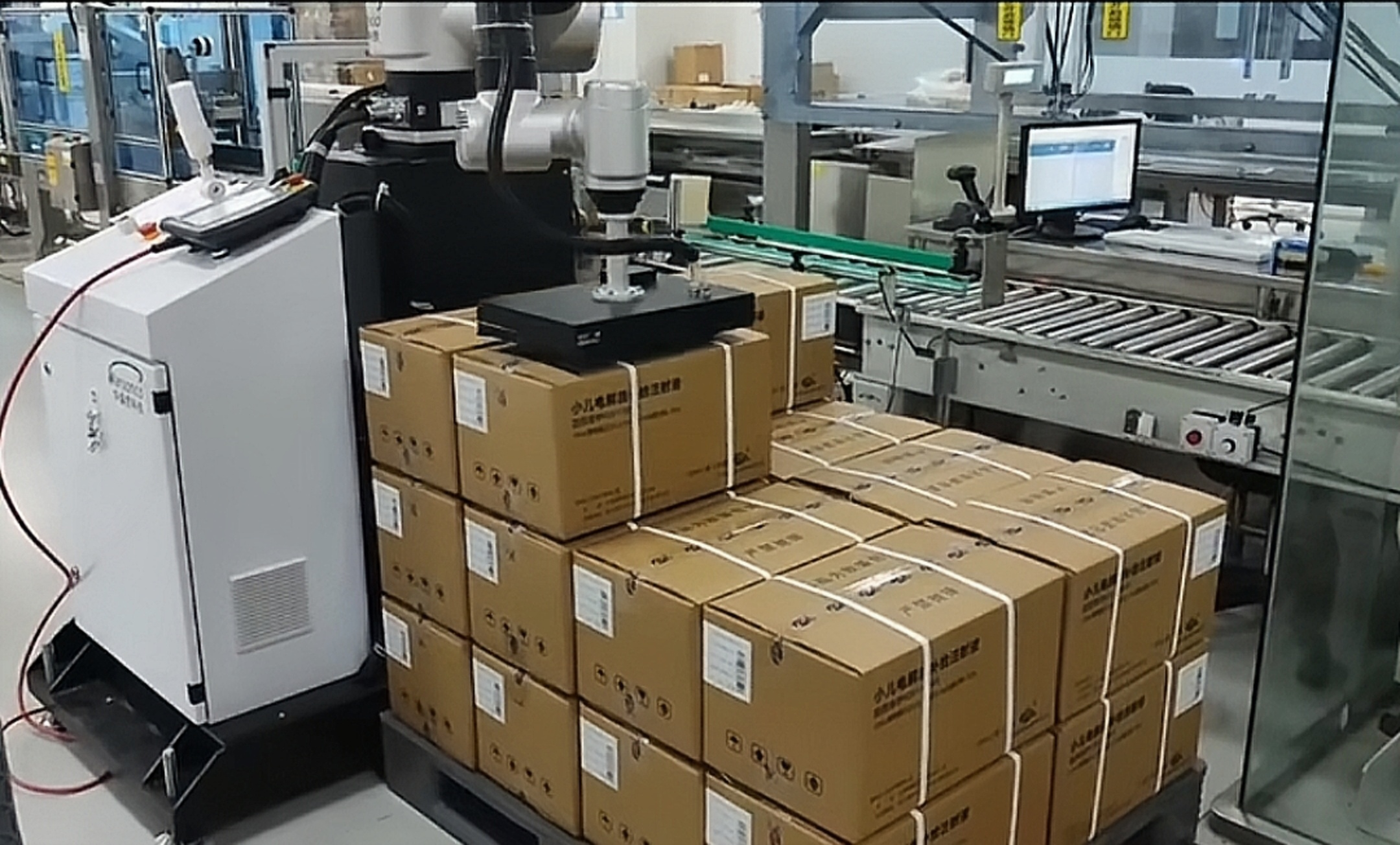
Primeiro, packaged products are conveyed to the palletizer via a conveyor belt. This step ensures stable product transport and eliminates the need for manual loading. Segundo, the palletizer’s end effector (such as suction cups or mechanical grippers) firmly grasps or holds the product—this component can be customized according to the product’s shape, peso, and material.
Terceiro, a control system driven by a PLC (Programmable Logic Controller) or artificial intelligence guides the end effector to move the product to a designated position on the pallet. The system is pre-set with stacking patterns (such as square stacking or staggered stacking) to ensure stacking stability. Finally, once a pallet is stacked, the machine moves the finished pallet to the designated area while automatically feeding in a new empty pallet, starting the next stacking cycle.
Modern palletizers are also equipped with user-friendly touchscreens, allowing operators to easily adjust parameters (such as stacking height, velocidade, and mode) to adapt to different product specifications.
Advantages of using a palletizer
Investing in a reliable palletizing machine (automated palletizer) brings numerous tangible advantages to enterprises, directly impacting production efficiency, cost control, and workplace safety—especially for [Target Industry: Logistics/Manufacturing] businesses. Below are the key benefits of integrating a palletizing system into your production line:
1. Reduce Labor Costs: A single palletizing machine can replace 4-6 manual workers, eliminating overtime pay, training costs, and management expenses. It operates continuously without breaks, maximizing production time and reducing labor turnover— a major benefit of automated palletizing for businesses of all sizes.
2. Improve Production Efficiency: Palletizing machines operate at a stable speed (up to [Number] products per hour), far faster than manual stacking. This reduces bottlenecks in the production line, increases overall output, and helps meet tight [Order Deadline] requirements— making robotic palletizer and mechanical palletizing systems essential for high-volume production.
3. Enhance Operation Safety: Manual stacking involves heavy lifting, which is prone to work-related injuries (such as back pain, muscle strains, or product drops). A palletizing machine eliminates these risks, creating a safer working environment and reducing workers’ compensation costs— a key advantage of automated palletizing solutions.
4. Ensure Stable Stacking Quality: Uniform stacking ensures pallets are stable, reducing the risk of collapse during transportation and storage. This minimizes product damage and loss, improves warehouse space utilization by up to [Percentage]%, and simplifies loading/unloading processes— a critical benefit of any high-quality palletizing system.
5. Strong Versatility and Customization: Most palletizing machines are compatible with various product types (bagged, cartoned, drummed, etc.) and can be customized with different grippers or stacking patterns to meet specific production needs, such as [Special Product Requirement: Heavy Load/Fragile Items] manuseio. This versatility makes robotic palletizer and collaborative palletizer models suitable for diverse industries.
6. Low Maintenance Requirements: The modular design makes palletizing machines easy to maintain, with fewer wearable moving parts. This reduces downtime, lowers maintenance costs, and ensures long-term reliable operation for [Service Life: 5-10 Years]— maximizing the return on your automated palletizer investment.
Common Application Scenarios of Palletizing Machines
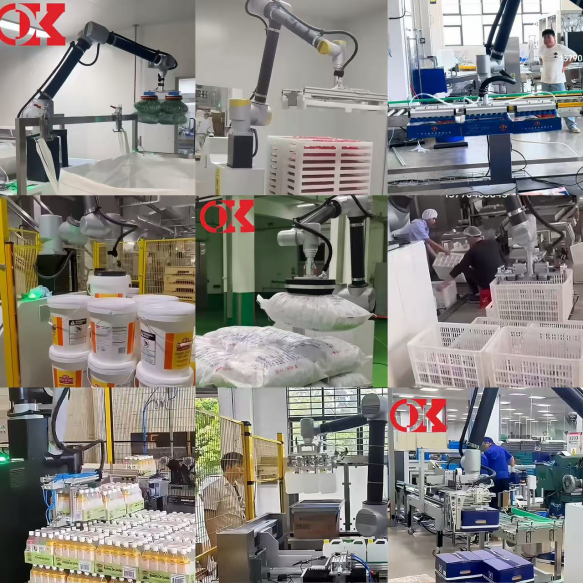
Palletizing machines (automated palletizer) are highly versatile and widely used in various industries that require efficient stacking of packaged products. Common application scenarios for robotic palletizer, collaborative palletizer, and mechanical palletizing systems include:
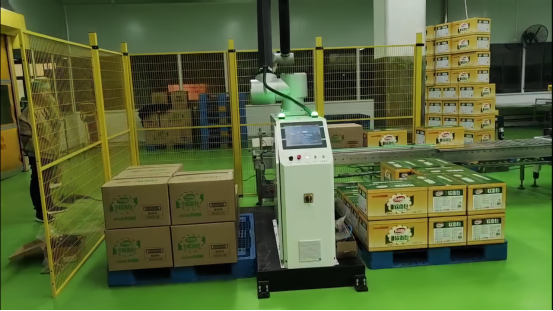
• Food and Beverage Industry: Stacking beverage cartons, snack packaging bags, or frozen food boxes with a food-grade palletizing machine, balancing hygiene and efficiency— a top use case for automated palletizing.
• Chemical Industry: Handling drummed/bagged products of chemical raw materials, fertilizers, or pesticides with a corrosion-resistant palletizing system, reducing human contact with dangerous goods— ideal for robotic palletizer models.
• Building Materials Industry: Stacking cement bags, mortar bags, or ceramic tiles with a heavy-duty palletizing machine, easily handling heavy objects that are difficult for manual workers to carry— a key application for mechanical palletizing systems.
• Feed and Agriculture Industry: Stacking animal feed, grain, or seed bags with a high-capacity automated palletizer, adapting to large-volume production needs— a common use for palletizing machines.
• Logistics and Warehousing Industry: Stacking cartons or packages for transportation and storage with a fast-acting palletizing system, simplifying the order fulfillment process— essential for modern logistics operations.
• Pharmaceutical and Daily Chemical Industry: Stacking medicine boxes, cosmetics, or cleaning products with a precision palletizing machine, ensuring stacking accuracy and hygiene— suitable for collaborative palletizer models.
Conclusão
A palletizing machine (automated palletizer) is a key equipment for enterprises to realize the automation of stacking processes, reduzir custos, e melhorar a eficiência. Whether you choose a robotic palletizer, collaborative palletizer, or mechanical palletizing system, integrating this equipment into your production line can streamline operations, enhance workplace safety, and increase enterprise profits. It’s a smart investment for businesses looking to stay competitive in smart manufacturing.
Whether you are a small enterprise or a large manufacturer, a suitable palletizing machine can adapt to your needs and bring long-term value. If you’re considering investing in a palletizing system, it’s recommended to focus on product compatibility, production capacity, customization options, and after-sales service to ensure that it meets your enterprise’s development goals. For businesses in [Target Region], choosing a local or trusted palletizing machine supplier can also simplify installation and maintenance.
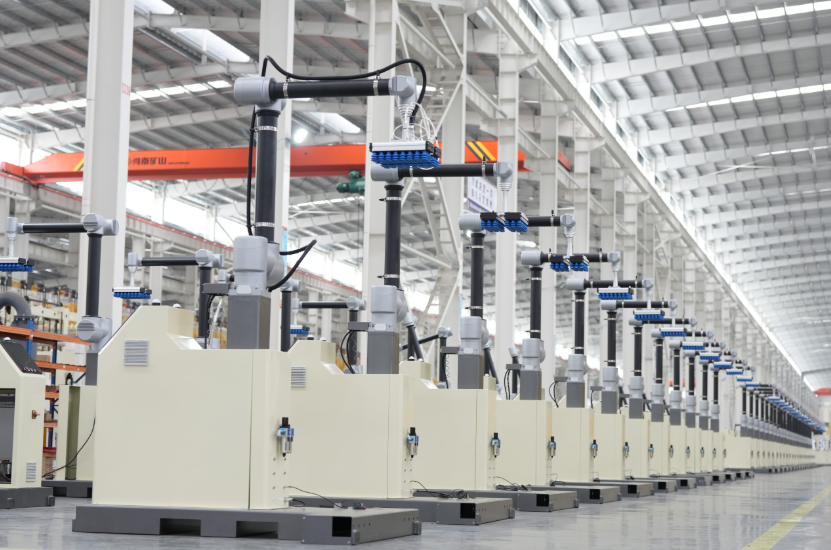
No processo de transformação e atualização da indústria manufatureira, a produção de máquinas automatizadas trouxe uma nova onda de revolução. Embora as fábricas tradicionais ainda estejam preocupadas com o aumento dos custos trabalhistas, gargalos de eficiência e riscos de segurança, OK Collabotive Palletizing Robot tornou-se a solução preferida para muitas empresas com as principais vantagens de “alta precisão, alta velocidade e alta flexibilidade”.
O que é um robô paletizador e como ele pode provocar uma mudança na fabricação.
Os robôs de paletização são robôs industriais que servem como nós críticos na logística de produção. Sua principal função é substituir o trabalho humano em tarefas de manuseio de materiais, como agarrar, empilhamento, e paletização (empilhamento) de mercadorias (por exemplo, caixas, bateria, bolsas). Apresentando alta precisão, velocidade, e flexibilidade, esses robôs realizam operações automatizadas por meio de um “percepção-decisão-execução” sistema. Isso aumenta a eficiência operacional, reduz as taxas de danos materiais, e reduz os custos trabalhistas. Eles são amplamente utilizados em indústrias, incluindo alimentos e bebidas, fabricação de máquinas, eletrônica, e armazenamento logístico.
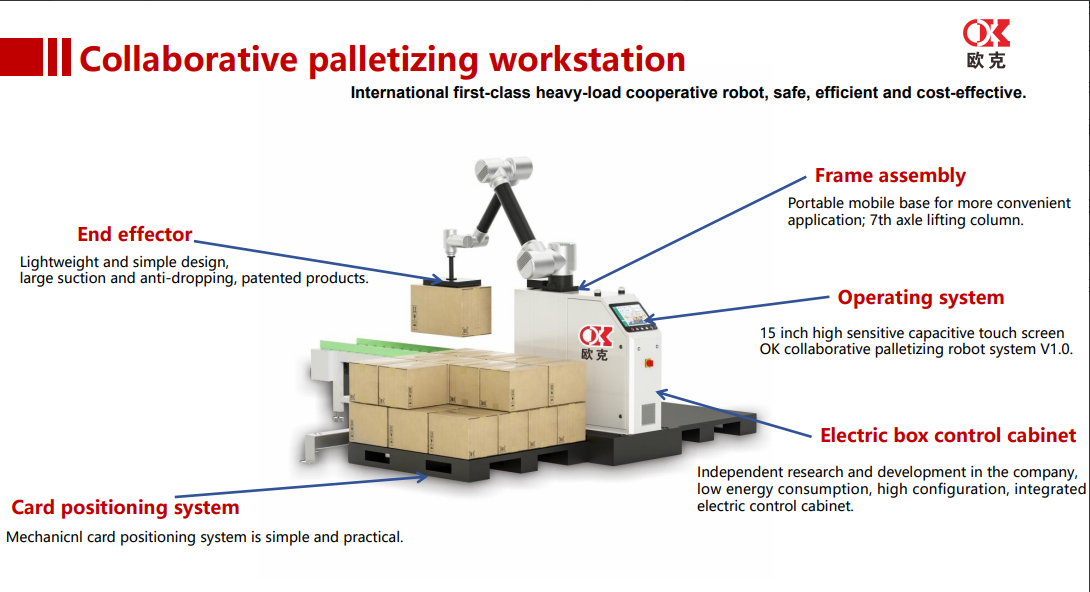
Componentes do Robô
Soluções personalizadas de robôs de paletização
Com sua forte adaptabilidade, robôs de paletização tornaram-se uma solução customizada em diversos setores. Para a indústria manufatureira, pode trazer valor central multidimensional.
Em quais indústrias os robôs de paletização podem ser usados
Robôs paletizadores podem ser usados no final de diferentes linhas de produção
Na indústria de alimentos e bebidas, pode atender aos requisitos de paletização de alta velocidade de água engarrafada e cerveja, e possui design de proteção asséptica para produtos assados;
Na área de materiais de construção químicos, pode realizar a captura anti-vazamento de cimento ensacado e fertilizante, bem como o empilhamento de pratos;
A indústria eletrônica e elétrica está equipada com dispositivos de fixação antiestáticos para paletização de placas PCB, e também pode fornecer soluções de paletização com proteção tampão para acessórios de eletrodomésticos;
No link de logística e armazenamento, suporta o empilhamento de código misto de pacotes de comércio eletrônico, e possui modelos resistentes a baixas temperaturas para se adaptar ao ambiente da cadeia de frio.
Que problemas os robôs de paletização podem resolver para a fabricação
Baixa eficiência: a paletização manual é limitada pela força física e atenção, resultando em altas flutuações de eficiência e dificuldade em acompanhar o ritmo das linhas de produção de alta velocidade
Perigo de segurança: manuseio manual de objetos pesados (como cimento ensacado, peças pesadas) é propenso a lesões musculares, lesões por esmagamento e outros acidentes, e as empresas precisam de suportar indemnizações elevadas por lesões relacionadas com o trabalho e perdas por interrupção da produção.
Precisão insuficiente: a paletização manual está sujeita a problemas como empilhamento inclinado e grandes espaços entre as camadas, resultando em desperdício de espaço de armazenamento e alta taxa de danos de materiais (como componentes eletrônicos e itens frágeis).
As deficiências da flexibilidade: leva muito tempo para o manual se adaptar a novos materiais e novos tipos de empilhamento, o custo de mudança da linha de produção é alto, e é difícil atender à tendência de produção de múltiplas variedades e pequenos lotes.
Os custos trabalhistas estão aumentando
Solução de robô de paletização
Os robôs de paletização podem operar continuamente por 24 horas com ritmos de produção estáveis, aumentando a eficiência da linha por 50%-150%. Um único robô pode substituir 3-5 trabalhadores qualificados. Com um custo médio anual de trabalho de 80,000 yuan, cada robô salva 240,000-400,000 yuan anualmente, e o período de ROI é geralmente menor que 8 meses.
O robô transporta cargas pesadas através de estruturas mecânicas, e com dispositivos de proteção como lidar, cerca de segurança e cortina de luz, a taxa de acidentes de manuseio pode ser reduzida em mais de 80%. A tecnologia de detecção de colisão também permite a colaboração homem-máquina sem isolamento, melhorando ainda mais a segurança.
O robô de paletização atinge precisão de posicionamento de ±0,04 mm com seu sistema de visão 3D, permitindo manuseio e empilhamento precisos de materiais. Este sistema otimiza a utilização do espaço para 95% mantendo uma taxa de danos materiais abaixo 0.5%.
O robô pode trocar materiais rapidamente (como caixas, bolsas, e partes irregulares) mudando os equipamentos (ventosas, pinças mecânicas, etc.) e ajustando programas, e suporta comutação flexível de vários padrões de empilhamento, como campo e flor de ameixa.
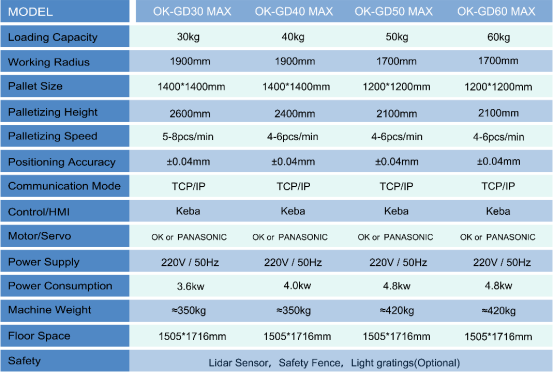
Principais parâmetros e recursos do robô de paletização:
Capacidade de Carga e Faixa Operacional:
O robô de paletização básico suporta carga útil de 20 a 60 kg
raio de trabalho de 1700 mm-1900 mm.
Acomoda tamanhos de paletes incluindo 1400*1400mm, 1200*1200milímetros, e outras configurações personalizadas.
Desempenho de paletização:
O sistema atinge uma altura de paletização de 2.100 mm a 2.600 mm
Opera velocidades: no 6-12 unidades por minuto, mantendo o desempenho estável. a velocidade diminui proporcionalmente com cargas mais pesadas.
Precisão de posicionamento: ±0,004mm.
Configuração do sistema:
Modo de comunicação: TCP/IP, sistema de controle: Tome cuidado.
Motor/Atuador: OK ou Panasonic.
Projeto estrutural e segurança:
Área base: 1050×1716mm, layout espacial padronizado.
Peso: 350KG-420KG.
Recursos de segurança: LiDAR, grades de segurança, grade opcional, múltiplas medidas de segurança. Processo de operação do robô paletizador.
Garra robô de embalagem; luminária flexível e estrutura ajustável
Nosso robô paletizador é flexível e pode combinar com qualquer produto.
Garras ajustáveis e ventosas de vários conjuntos, com espaçamento ajustável via cilindro ou acionamento motorizado, para acomodar diversas variações de tamanho do produto
.Design de fixação de troca rápida; interface padronizada para substituição rápida de acessórios dentro 5 minutos
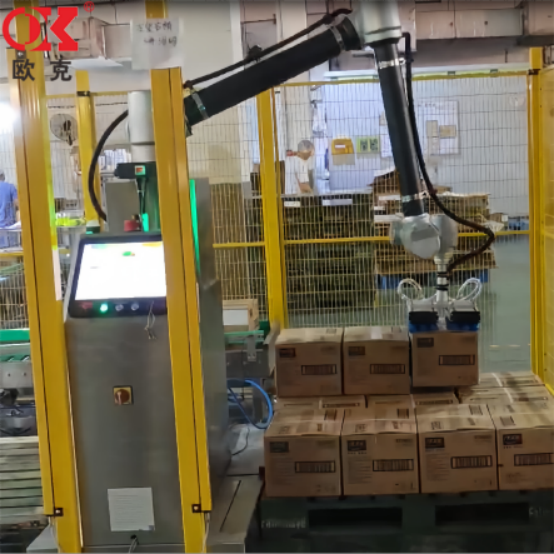
Caixa de ventosa de papelão:
Como operar o robô paletizador
Operação básica: Chame o programa predefinido (selecione o pré-programa para o material correspondente, que inclui parâmetros como caminho de captura e plano de empilhamento de paletes) —–Confirmar parâmetros (verifique a altura do palete, especificações de paletes, espaçamento de empilhamento, etc.) —–Iniciar operação—–Parada de emergência
Com visão 3D e o “Reconhecimento automático” recurso ativado, o robô pode escanear locais de materiais em tempo real sem posicionamento manual, tornando-o adequado para cenários com leve deslocamento de material
Quando vários robôs operam em coordenação, selecione “Modo Colaborativo” no gabinete de controle para definir regras de alocação de tarefas (por exemplo, divisão por ritmo de linha de produção) e garantir que não haja interferência de colisão.
Por que escolher o robô de paletização colaborativo OK
OK empresa listada marca de primeira linha da China
Operação de alta precisão: Equipado com sistema de reconhecimento visual 3D e algoritmo de aprendizagem profunda, a precisão de preensão em ambiente dinâmico atinge ± 0,04 mm.
Adaptação de alta flexibilidade: A comutação inteligente de materiais de vários tamanhos é suportada pelo algoritmo de controle de movimento, que pode escanear o tamanho do objeto em tempo real através da visão e planejar automaticamente o caminho, e pode processar dois produtos diferentes ao mesmo tempo.
Longevidade e desempenho estável: pode ser usado para 6-7 anos, e marcas importadas podem ser usadas para 8 anos.
Alta relação custo-benefício e rápido retorno do investimentoO serviço de ciclo de vida completo elimina preocupações pós-venda
Design de solução personalizada: fornecer pesquisa gratuita de linha de produção e teste de simulação, e personalizar a solução de acordo com o local do cliente e as características do material.
Entrega rápida e treinamento: 100,000 metros quadrados de fábrica, o ciclo de entrega mais curto de 7 dias, “on-line + off-line” treinamento de operação, funcionários comuns podem dominar rapidamente a programação básica em 2 horas.
Perguntas frequentes (Perguntas frequentes):
P: Como o robô paletizador lida com objetos de diferentes tamanhos?
UM: O robô paletizador processa com eficiência objetos de tamanhos variados através de uma combinação de “flexibilidade de hardware e controle dinâmico inteligente”. A lógica central segue a sequência: “primeiro reconhecimento, então adaptação, seguido de execução”.
P:Qual é o preço de um robô paletizador?
UM: O período de retorno para usar um robô paletizador é 6-12 meses. OK Robotics é um fabricante direto, sem intermediários, oferecendo preços competitivos.
P:Quanto à manutenção pós-venda, qual é a garantia de qualidade?
UM: O período de garantia do paletizador é de um ano. Após o período de garantia, ainda forneceremos orientação remota. Após o período de garantia, se a configuração estiver quebrada, podemos vendê-lo pelo preço de custo.
The global palletizing robot market is undergoing a profound transformation. Driven by technological advancements and evolving market demands, palletizing robots have evolved from mere tools for labor substitution into indispensable core components within smart factory ecosystems. This article explores the latest developments and future trends in the palletizing robot industry.
Core Drivers: From Cost Control to Strategic Value
Market growth is no longer solely driven by labor cost considerations. The explosive growth of e-commerce logistics, increasing emphasis on workplace safety and ergonomics, and the urgent need to build Industry 4.0 digital factories collectively fuel the adoption of palletizing robots. Companies invest in palletizing robots to enhance supply chain resilience and enable data-driven decision-making, thereby securing long-term competitive advantages.
Four Major Trends in Technological Evolution
1.Deep Integration of AI and Vision Guidance
Traditional “blind palletizing” is rapidly being replaced by vision-guided systems. 2D/3D vision systems enable robots to accurately identify and locate randomly oriented cartons or bagged products. Mais importante, Artificial Intelligence (AI) and Machine Learning (ML) algorithms are being deployed for defect detection (identifying damaged cases before palletizing), optimizing pallet patterns, and enabling predictive maintenance, significantly enhancing system intelligence and reliability.
2. The Rise of Collaborative Robots
Collaborative palletizing robots are becoming the ideal choice for small and medium-sized enterprises (SMEs) and flexible production environments. They can work safely alongside humans in shared spaces without the need for heavy safety cages required by traditional industrial robots, offering rapid and flexible deployment. With continuously improving payload capacities (now exceeding 25kg), cobots are expanding into more medium-to-low-speed palletizing applications.
3. Software and Digital Ecosystem as a Core Competitiveness
The industry’s competitive focus is shifting from hardware performance to software and digital services. Advanced Offline Programming (OLP) software allows for debugging and product changeovers in a virtual environment, minimizing production downtime. Furthermore, robots connected via IoT platforms enable remote monitoring, data analytics, and energy management, providing users with unprecedented operational insights and control.
4. Modularity and“Plug-and-Play”Design
To shorten delivery cycles and reduce integration complexity, modularity and standardization have become key directions in product design. “Plug-and-play” palletizing cells, which integrate the robot, end-effector, and control system, significantly simplify installation and commissioning, making the deployment of automation solutions as straightforward as installing standard equipment.
Future Outlook
In the future, palletizing robots will be more deeply integrated into smart logistics systems, working seamlessly with Autonomous Mobile Robots (RAM), smart forklifts, and Warehouse Management Systems (WMS). The ultimate goal is no longer to complete a task in isolation, but to function as an intelligent node within an entire flexible, adaptive, and highly efficient material handling system, dynamically responding to real-time demands and continuously creating value for businesses.
In today’s era of intelligent and digital manufacturing, vision inspection technology has become a critical enabler for ensuring product quality and enhancing production efficiency. Traditional reliance on manual visual inspection is not only inefficient and susceptible to subjective factors but also falls short in enabling continuous data traceability and analysis. Implementing an advanced vision inspection system facilitates fully automated quality monitoring throughout the production process, significantly reducing escape rates and false calls. Simultaneously, it enables real-time data acquisition and analysis of the production process, providing a scientific basis for quality improvement and process optimization.
With stable, reliable, and repeatable inspection results, enterprises can effectively increase the First Pass Yield, reduce material waste and lower production costs, and establish a systematic quality traceability framework. The OKBOLONG Vision Inspection System is built upon this very value proposition, combining cutting-edge vision technology with deep industry insights to deliver quality solutions that exceed customer expectations.
I. Deep Industry Expertise, Comprehensive Application Coverage
The OKBOLONG Vision Inspection System is not a generic solution; it is born from a profound understanding of specific industries. We possess unparalleled, extensive experience, particularly in the hygiene products sector, achieving comprehensive inspection coverage across product lines such as sanitary napkins, diapers, training pants, mattress pads, and nursing pads.
Core Inspection Capabilities Include:
Material Defect Detection:Precisely identifies core pad stains, blue sand, foreign objects, etc..
Structural Integrity Inspection:Ensures wing folds are correct, seals are tight, and tear tape positions are accurate.
Process and Positioning Inspection:Performs inkjet code verification, ultrasonic weld point inspection, front/back waistband positioning detection.
Industry-First Technologies:The unique Bottom Film Positioning Vision System can replace traditional photoelectric sensors without modifying the host machine’s program. This saves 5-8 waste pieces per material roll change, directly reducing costs and increasing efficiency for customers. Concurrently, the innovative Dual-Strobe Flash Technology enables simultaneous front-lighting and back-lighting imaging at a single station, overcoming challenges in inspecting complex structures.
II. Flexible Configuration, Dual-Brand Strategy Meets Diverse Needs
To meet the requirements of differently positioned customers, Okobolon offers two main product lines: world-renowned brand systems and our own proprietary brand systems, providing flexible choices.
Keyence Vision Systems:Renowned for their powerful, high-precision hardware and unique inspection algorithms. They are suitable for applications demanding extreme speed and accuracy. The systems offer high scalability, compatibility with various industrial communication protocols, and can be rapidly integrated into diverse automated production lines.
Proprietary Brand Vision Systems:Emphasize high flexibility and customization. The code algorithms can be deeply customized based on customer needs, and parameter adjustment is more intuitive and user-friendly. The unique One-Click Reproduction Function quickly pinpoints alarm causes, and the built-in data statistical analysis module accurately exports reports, greatly facilitating subsequent quality traceability and analysis.
III. Technology-Driven, Building a Solid System Foundation
Diversified Lighting and Imaging Solutions:Offers a wide variety of light source types and lighting methods, compatible with both area scan and line scan cameras, ensuring the clearest image capture in any complex production environment.
Simplified and Integrated Control Unit:Utilizes self-developed microcontroller-based control units with plug-and-play interfaces, significantly simplifying field installation and wiring, while reducing connection faults and troubleshooting time.
Powerful Data Statistical Analysis Platform:The system not only performs real-time inspection but also empowers production management. It provides a complete production data dashboard, defective product pie charts/bar graphs, defective image storage and query functions, and supports data filtering by time period with one-click Excel export, offering crucial data support for quality management and process optimization.
For a long time, the tissue paper industry has been plagued by numerous quality control pain points. Due to the complex production process and limitations of traditional machine vision technology, manufacturers mostly rely on manual visual inspection of finished products, which easily leads to missed detection of defective products. This not only increases labor costs but also causes a great waste of raw materials. Ao mesmo tempo, appearance issues such as bag bursting, paper damage, and missing date codes have emerged in the market, seriously affecting consumers’ first impression of the brand.
FPGA system inspection interface
Inspection image
The system installed on-site
Visual inspection machines focus on the entire process of the clean post-processing workshop. Starting from the base paper inspection in the folder section, they use FPGA technology, 8K cameras, and other tools to accurately identify defects such as stains and holes. Then, before the paper is put into bags, they inspect the paper’s size and stains to avoid packaging machine failures. Próximo, they conduct appearance inspection on small and medium packages, relying on AI deep learning algorithms to detect problems like bag bursting and coding errors. Finally, they check for missing packages and tape adhesion through carton packing inspection, forming a full-chain quality control system.
Packaging defect detection
This approach not only reduces batch quality problems from the source and lowers material consumption but also replaces manual inspection, significantly saving labor costs. The single-camera dual-strobe photography technology also reduces equipment investment. Meanwhile, it prevents defective products from entering the market, reduces consumer complaints, and enhances brand reputation.
Industry data shows that skilled workers can only complete 15 standard pallets per hour in appliance palletizing operations. Due to variations in product weight and size, the incidence of work-related injuries is 30% higher than in other industries. More seriously, the instability of manual stacking leads to a transportation damage rate of up to 2.5%.
Addressing the specific needs of the electrical industry, palletizing robots can automatically identify surface characteristics of different products and dynamically adjust gripping force, ensuring stable handling performance for diversified products. Their flexible design allows mixed palletizing of large units like air conditioner outdoor units and small household appliances on the same production line.
In quality assurance, the transportation damage rate drops dramatically from 2.5% para 0.18%. Regarding compliance, the automatically generated stacking patterns fully meet international transportation requirements, reducing overseas customer complaint rates by 37%. Most notably, palletizing robots increase efficiency by 300%, reduces labor costs by 60%.
The daily chemical industry faces immense market pressures: a vast number of products, diverse packaging specifications, volatile order demands, and rising labor costs. During e-commerce sales peaks, the high cost and difficulty of training temporary workers make it challenging to meet surging order demands.
Palletizing robots automatically identify and grip various products—from detergent bottles and cosmetic boxes to toothpaste cartons—seamlessly adapting to production line changes. With speeds of up to 700-1000 cases per hour and 24/7 operação, they dramatically boost output. Flexible end-of-arm tools and programmable logic allow a single robot to handle over 90% of product variants on a line, significantly enhancing production flexibility.
For customers, investing in palletizing robots translates into significant long-term returns. They reduce labor costs by up to 70%, while entirely eliminating work-related injuries and stacking errors caused by human fatigue. Most importantly, robots provide immense flexibility to handle market fluctuations. Companies can effortlessly manage peak sales events like “Singles’ Day,” shortening delivery cycles by 30% and swiftly capturing market opportunities.
Manual palletizing is inefficient and prone to errors due to fatigue, which may impact drug traceability and supply chain security. Additionally, GMP demands environmental cleanliness and operational consistency, which are difficult to achieve fully with manual operations, risking contamination.
Palletizing robots can accurately handle various pharmaceutical packaging (por exemplo, boxes, garrafas) at speeds of up to 800-1000 boxes per hour, with an error rate below 0.01%. They also operate in sterile environments, minimizing human intervention and complying with GMP standards. Palletizing robots can increase warehouse efficiency by 30% and reduce operational costs by 15%.
Customers benefit from a more efficient supply chain and reduced risks. Palletizing robots ensure standardized stacking and accurate traceability information, reducing recall risks. In the long term, the high return on investment (typically ROI in 1.5-2 anos) supports flexibility in meeting market demands, such as urgent tasks like vaccine distribution.
Cesto de compras
Consulte para mais detalhes do produto
Preencha o formulário abaixo e entraremos em contato o mais rápido possível.